Please wait while the page is loading...

loader

The patenting of GMOs

29 September 2026

The patenting of GMOs

The same genetically modified technology can face very different patent rules depending on where it is developed or used.Espie Angelica A. de Leon examines how different jurisdictions draw different boundaries around GMO-related inventions and what those differences mean for farmers, biotechnology and food production.

In 1980, the U.S. Supreme Court announced its landmark decision in Diamond v. Chakrabarty, a case which straddled the fields of technology, agriculture and law.

Diamond v. Chakrabarty involved Indian American microbiologist and General Electric (GE) employee Ananda Chakrabarty and the U.S. Patent and Trademark Office (USPTO), headed by Commissioner Sidney Diamond. As a GE employee, Chakrabarty genetically engineered a new bacterium which can break down crude oil, thus providing a solution to oil spills. Not a single naturally occurring bacterium can do the same. Chakrabarty filed a patent application for his invention, assigned to GE, in 1972. The USPTO rejected the application, stating that living things are not patent-eligible because they are products of nature.

On June 16, 1980, the U.S. Supreme Court issued its ruling: human-made genetically engineered, or genetically modified, living organisms, including microorganisms, as opposed to “un-modified products of nature,” can be patented.

According to Merriam-Webster, a genetically modified organism (GMO) is “a plant, animal or microorganism whose DNA has been altered artificially through the insertion, deletion or modification of one or more genes to express or suppress a targeted trait or traits.” The process of altering or modifying is achieved via any of the techniques of modern molecular biology, including genetic engineering. In other words, these organisms are used in biotechnology to produce new substances and have new properties or functions.

So yes, generally speaking, GMOs are eligible for patent protection provided they meet the requirements of novelty, inventive step and industrial applicability.

In the case of patented GMO seeds, farmers may have to sign licensing agreements with the company that owns the seeds to buy them. Certain provisions in these licensing agreements may ban the saving or replanting of the harvested seeds by the farmers. Other breeders, researchers and farmers may be required to pay royalties if they want to use, reproduce or introduce further alterations or modifications to the organism.

GMO patenting in China, the Philippines, India and Indonesia

GMOs are generally patentable, but details in the legalities concerning GMOs and patents across Asian countries vary.

In China, genetically modified plants are generally patent-eligible unless the claims explicitly relate to a plant variety meeting the distinctness, uniformity and stability (DUS) criteria and eligible for plant variety right protection. These criteria are assessed at the population level for plant varieties.

“For example, genetically modified plants and their propagating materials derived from a wild plant found in nature are no longer regarded as plant varieties if they do not exhibit uniformity in morphological and biological characteristics or relatively stable genetic traits in their populations. As a specific example, a genetically modified plant incorporating or containing an exogenous gene sequence but without population-level DUS uniformity qualifies for patent protection. Accordingly, genetically modified plants and their propagating materials such as shoots, tillers, followers, cells or tissues, etc., are generally patent-eligible,” explained Xiaona Chen, a senior patent attorney at CCPIT Patent & Trademark Law Office in Beijing.

China is an agricultural biotechnology patent-heavy country and the Asian frontrunner in plants and GMO-related patent filings. Its research organizations account for a substantial slice of plant-related patents globally. Leading biotech firms such as Bayer continuously file patent applications in China and other Asian jurisdictions.

On the other hand, complete genetically modified animals are classified as an animal variety and are not patentable in China. These include animal embryonic stem cells, individual animals and materials at all stages of animal formation and development, such as germ cells, fertilized eggs and embryos.

Patent eligibility includes two categories of biological materials from the definition of animal variety: 1) genetically modified animal somatic cells such as transgenic fibroblasts, hepatocytes, immune cells or transgenic tumour cell lines, among others; and 2) genetically modified animal tissues and mature animal organs (excluding embryos) such as liver, muscle or skin tissues.

Genetically modified microorganisms, such as transgenic microorganisms, are eligible for invention patents, as long as they are novel, are imbued with an inventive step and are industrially applicable.

Meanwhile, GMOs formed by human germ cells with gene modification are barred under Article 5 of the Patent Law, as these violate public morality, bioethics and biosafety rules. “No patents are granted for inheritable human germline GM products and related editing methods. Moreover, any GMOs developed through unauthorized access to genetic resources, prohibited biosafety experiments or violations of China’s Biosafety Law are entirely denied patent protection,” added Chen.

She said their firm has extensive experience in prosecuting GMO patent applications. In fact, the team pioneered the claim strategy for protecting the “GMO genome” and has successfully obtained multiple patents using this strategy, including Patent Nos. ZL201780015045.8 and ZL201480063162.8, protecting a genetically modified rodent genome.

“When drafting an application directed to a genetically modified plant, besides claims covering methods for producing said genetically modified plant, food products comprising said genetically modified plant or related uses, we recommend drafting a product claim by defining a genetically modified plant that contains or expresses an exogenous gene sequence, without population-level uniformity or stability limitations. Furthermore, we recommend adding a claim directed to ‘a genome of a genetically modified plant.’ This claim type delivers particular value where the whole genetically modified plant itself is deemed a plant variety and cannot be patented,” advised Chen.

Under the IP Code of the Philippines, the following are patent-eligible if they meet the requirements of novelty, inventive step and industrial applicability: genetic constructs, vector systems, molecular editing techniques, gene isolation methods related to GMOs, a sequence or partial sequence of a gene if produced by a technical process, among others. Plant varieties, animal breeds or essentially biological processes for the production of plants or animals are ineligible for patents.

Among the GMO-related inventions that have been granted patents in the Philippines are PH12017501957 entitled “Herbicide-Tolerant Maize Plant DBN9858, and Nucleotide Sequence and Method for Detecting Same”; PH12017501967 entitled “Maize Plant DBN9936 and Method for Use in Detecting Nucleic Acid Sequence Thereof” and PH12018000119 entitled “A Transgenic Plant and the Method for Producing the Same”.


“GMO is a specific category within biotechnology. While GMO-related inventions can be patented and GMO plant varieties can be registered with the Plant Variety Office under the Plant Variety Act, said products cannot be freely grown and commercialized without approval,” stressed Editha Hechanova, president and CEO of Hechanova and Co., Inc. and managing partner of Hechanova, Bugay, Vilchez & Andaya-Racadio in Manila. Approval must be obtained from multiple agencies. These are the Department of Agriculture through the Bureau of Plant Industry, which evaluates and issues biosafety permits for the commercial propagation, field testing and direct use of genetically modified plant and fishery products; the Department of Health; the Department of Environment and Natural Resources;theDepartment of Science and Technology;and the Department of the Interior and Local Government, which coordinates local government awareness and compliance.

The Philippines was introduced to biotechnology way back in the ‘70s, emerging as one of the first countries to adopt biotechnology crops such as the insect-resistant Bt corn and to develop the beta-carotene-producing Golden Rice. It is also the first in Southeast Asia to set up a biotechnology regulatory framework via the establishment of the National Committee on Biosafety of the Philippines.

Hechanova shared that their firm has engaged in patent work for GMOs. “By way of example, it involved Methods and Compositions for Improving Plant Traits, and was granted patent PH12018500103 in the name of Pivot Bio, Inc., a U.S. company with headquarters in Minnesota, which develops sustainable agricultural solutions to enhance crop yield and profitability. We are handling other applications still in the examination stage,” she revealed.

As for India, Payal Kalra, a partner at Remfry & Sagar in Gurugram, said: “India’s legal framework maintains a deliberate and cautious boundary regarding the patentability of GMOs, allowing protection primarily for genetically modified microorganisms and certain biotechnological inventions relating to GMOs. Section 3(j) of the Indian Patents Act, 1970 explicitly excludes plants, seeds, animals and parts thereof from patent protection, even if they are genetically modified, reserving them for alternative legal frameworks.”

What may be eligible for patent protection are their underlying biotechnological innovations such as novel genetic constructs, recombinant DNA molecules, expression cassettes, promoters and other engineered genetic elements.

“Technical processes involving genetic engineering, gene insertion, transformation techniques and tissue culture methods may also be patentable, provided they are not considered ‘essentially biological processes’ and involve substantial human intervention.”

Kalra said their firm has likewise had extensive experience as far as patent work for GMOs are concerned, spanning inventions relating to engineered cell lines, recombinant DNA/cDNA, recombinant vectors, and their associated production and cultivation processes, alongside processes for producing and modifying GM plants.

“Given that genetically modified microorganisms fall outside the statutory exclusions of Section 3(j) read with Section 3(c), patenting in this space also requires careful navigation of biological material deposit requirements,” she noted. “Where a microorganism cannot be fully described in the specification to enable a person skilled in the art to replicate the invention, a deposit must be made with a recognized International Depositary Authority pursuant to the Budapest Treaty and Section 10(4) of the act. Navigating these disclosure and deposit requirements forms a critical component of our prosecution strategies.”

As in other jurisdictions, inventions associated with the GMO and not the genetically modified plant itself may be patent eligible in Indonesia as long as they satisfy the statutory requirements. “In particular, where GMOs are derived from a non-essential biological process, meaning that it involves technical intervention from humans. The technical intervention may include, for example, tissue culture techniques, genetic transformation and genome editing, which may be used to propagate desired genetic traits. The process for producing such GMOs can be considered as a patentable invention in Indonesia,” said Rizka Khairunnisa, an associate at K&K Advocates in Jakarta.

GMOs, patents and food supply

By the 1990s, GMOs had become popular and had eventually found their way into more food items in the form of synthetic milk products, apples that don’t turn brown, papayas that are resistant to the ringspot virus, salmon with growth-hormone genes and many more.

This development sparked a discussion. While advocates of GMO patenting insist that patents encourage innovation, other sectors including farmers and environmental groups, argue that it allows only a handful of large business enterprises to control the world’s food supply.

In the section “Corporate Control: GMOs and Patents” on the website of the non-profit organization The Non GMO Project, the third paragraph reads: “Patent law is complex and costly, which provides a distinct advantage to large corporations. Utility patents on seeds helped to consolidate power in the hands of big business. Independent breeders have been targeted and intimidated by patent holders who use corporate resources to fund costly legal challenges. Large companies buy or force out smaller ones. Today, more than half of the world’s seeds are controlled by just four multinational corporations.”

The article proceeded to explain that corporations focus on seed traits that spell profit, namely yield, uniformity or resistance to herbicides. On the wayside, other equally important traits are set aside, namely, taste, nutritional profile and resilience, simply because they don’t translate to generous cash flows.

Meanwhile, patented seeds don’t reach the hands of other breeders or researchers. This means these breeders cannot develop new plant varieties, which would have benefited the human race.

“As GMOs made from new genomic techniques enter the market, we face a new era of privatization in which a single company can patent and control the genetic formula and fermentation process used to create synthetic milk, protein or honey,” the article continues.

Risti Wulansari, a partner at K&K Advocates in Jakarta, disagreed. Rather than viewing the patenting of GMOs as an attempt to establish a legal monopoly over the world’s food supply, she said their firm sees it as a legitimate means of recognizing and rewarding the efforts of inventors and companies and their investments in research and development.

“The development of GMOs typically requires substantial financial resources, technical expertise and years of scientific research. Patent protection serves as an incentive by allowing innovators to recoup these investments for a limited period, thereby encouraging continued advancement in agriscience and biotechnology,” said Wulansari.

“Furthermore, the patenting of GMO-related inventions may foster further innovation by motivating researchers and competitors to develop improved or alternative technologies,” Khairunnisa added. “Such follow-on innovations may result in crops with enhanced yields, greater resistance to pests and diseases, improved tolerance to environmental stresses or enhanced nutritional value. In the long run, we believe that these technological advancements have the potential to contribute to food security and the broader objective of sustainable agriculture.”

“It would be an overgeneralized claim rather than an absolute truth,” Chen remarked. According to her, such concerns are partly valid with respect to certain regions. In these parts, she said, large agricultural multinationals own most key GM agronomic trait patents and seed licensing contracts prohibit farmers from saving seeds.

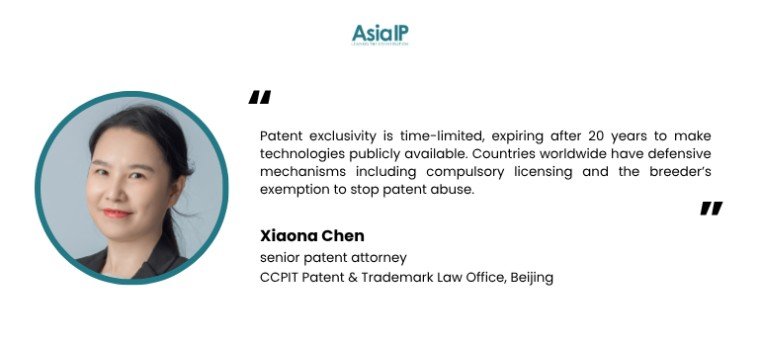
“Patent exclusivity is time-limited, expiring after 20 years to make technologies publicly available. Countries worldwide have defensive mechanisms including compulsory licensing and the breeder’s exemption to stop patent abuse. More importantly, food supply is determined by agricultural growing conditions, governmental trade policies, grain stockpiles and biosafety supervision. Patent holders control only breeding technologies rather than the full food chain, making comprehensive manipulation of food production impossible,” explained Chen.

She added that DUS-compliant GM crop varieties cannot be patented in accordance with the law. “Supported by genetic resource disclosure requirements, biosafety market approval, farmers’ legal right to save seeds and antitrust regulation, neither foreign nor domestic enterprises can monopolize staple food crops by holding GMO patents. Numerous domestic GMO patents are held by public research institutions, providing low-cost alternative technical solutions for domestic crop breeding,” she revealed.

Hechanova disagreed as well. “First, countries have different ways of dealing with GMOs. But what these large companies have power over are the GMO seeds, which give farmers higher and better crop yields and higher revenues, but farmers probably have to sign technology agreements preventing them from replanting said seeds and have to buy new seeds every time. However, these large companies have to deal with their seeds being counterfeited, which could be costly, or planted in other locations by natural means,” she said.

As far as India is concerned, Kalra said its legal framework balances innovation with the prevention of excessive proprietary control over food resources. Since plants, animals, seeds and plant varieties are patent ineligible, then agribusinesses cannot acquire patent protection for their GM seeds or plant varieties. Such framework eliminates the risk of concentrating seed ownership in the hands of a few, namely the huge corporations. “India’s sui generis system balances Plant Breeders’ Rights with robust Farmers’ Rights. Under this law, subject to certain limitations, farmers retain their traditional rights to save, use, sow, re-sow, exchange, share or sell farm produce obtained from a protected variety,” explained Kalra. “Ultimately, through this balanced approach, India successfully encourages biotechnological innovation without compromising its food security or the livelihoods of farmers.”


Law firms