


The ‘look’ is the ‘brand’: Delhi High Court extends trademark protection to visual identity
04 August 2026

In January 2026, the High Court of Delhi ruled that a digital broadcaster’s logo infringed on a well-known broadcaster’s similar visual identity. Rahul Beruar, who argued the case, explains how the court was able to separate the visual device, colour scheme and layout from the choice of name by the upstart broadcaster.
In today’s relentlessly expanding digital media landscape where audiences form opinions in the span of a glance, a logo often carries the weight of an entire brand – rendering the boundary between creative influence and outright imitation more significant than ever. Against the backdrop of an increasingly saturated digital news ecosystem, visual identity has emerged as a defining competitive asset. As logos become the primary point of audience recognition, the distinction between legitimate inspiration and visual imitation assumes heightened importance.
Understanding this significance, the High Court of Delhi faced an important question in Living Media India Limited and Another v. Charcha Aaj Ki, CS(COMM) 15/2026, 2026 SCC OnLine Del 193, High Court of Delhi, decided on January 9, 2026: Whether Charcha Aaj Ki, a digital news channel operating on popular platforms like JIO TV and YouTube, had crossed that distinction by adopting a strikingly similar logo to that of the iconic and well-known news channel AAJ TAK.
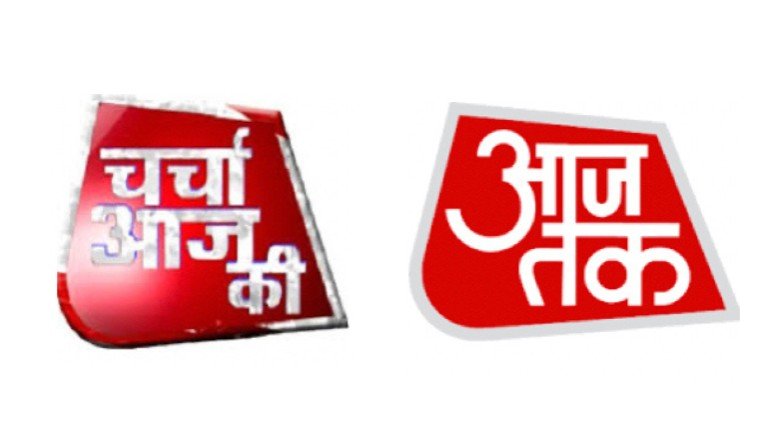
The High Court of Delhi determined that a mark used by digital news channel Charcha Aaj Ki, left, infringed on that of AAJ TAK due to its colour scheme and layout.
The dispute traces back to December 2025, when AAJ TAK discovered a digital news channel operating under the name Charcha Aaj Ki on the JIO TV platform. Extensive investigation conducted by AAJ TAK’s counsels revealed that Charcha Aaj Ki was using a device mark which was deceptively similar to AAJ TAK’s prior registered and declared well-known trademark, replicating the same red-white-black colour combination and layout across its website, YouTube channel, Facebook and Instagram accounts, without any valid authorization.
It was against this backdrop, that the Delhi High Court was called upon to resolve three distinct legal questions: first, whether the defendant’s use of a visually similar device mark constituted trademark infringement under Section 29(1) and (2) of the Trade Marks Act, 1999; second, whether the defendant’s conduct amounted to passing off by misrepresenting its services as those of the plaintiffs under common law; and, third, whether the urgency of the relief sought justified exempting the plaintiffs from the mandatory pre-institution mediation requirement under Section 12A(1) of the Commercial Courts Act, 2015.
Pursuant to an interesting courtroom exchange, AAJ TAK’s counsels successfully established the deliberate and blatant imitation by Charcha Aaj Ki of the visual identity, intentional use of the same colour combination and the distinctive well-known trademark built by AAJ TAK over decades of journalistic excellence.
Notably, AAJ TAK’s counsels drew a careful distinction: They explicitly stated they had no objectionto the use of “Charcha Aaj Ki” as a word mark by the channel, and the grievance was narrowly targeted at the replication of the visual device, the colour scheme and layout, and not at the choice of name Charcha Aaj Ki by the channel, thereby indicating their aim to protect AAJ TAK’s visual identity. It is in this regard, that the court affirmed the inevitable confusion to be caused by use of the deceptively similar logo by Charcha Aaj Ki, in favour of AAJ TAK.
At the procedural end, AAJ TAK’s counsels also justified why the court should bypass the mandatory pre-institution mediation requirement under Section 12A (1) of the Commercial Courts Act, 2015. Relying on the Supreme Court’s ruling in Yamini Manohar v. T.K.D. Keerthi (2024) 5 SCC 815 and a Division Bench decision of the Delhi High Court in Chandra Kishore Chaurasia v. RA Perfumery Works Private Ltd. (2022), both of which recognized that urgency of relief is a valid ground for exemption from pre-litigation mediation, which the court permitted for AAJ TAK as well.
This landmark case also throws light on the sanctity of well-known trademarks in India being accorded the highest standards of brand protection, the dilution of which can never be adequately remedied, once AAJ TAK’s counsels successfully proved the visual similarity and shared trade channels.
However, the most significant aspect of the court’s determination lies in the carefully circumscribed nature of the injunction. The restraint was by no means absolute. Instead, the Court agreed with AAJ TAK’s counsels’ clear and deliberate distinction that Charcha Aaj Ki should be restrained from using the impugned device mark but that it can continue using the word mark “Charcha Aaj Ki”. This nuanced differentiation underscores that the counsels’ objection was not directed at the adoption of the name or underlying concept per se, but rather the conscious appropriation of a distinctive visual identity that had, through sustained use, acquired an exclusive association in the minds of the public with AAJ TAK.
Having agreed with the counsels that AAJ TAK had established a prima facie case, demonstrated the balance of convenience in their favour and shown the likelihood of irreparable harm, the court consequently granted an ex parte ad interim injunction against Charcha Aaj Ki, restraining them from using the device mark to the extent it resembled AAJ TAK across all platforms, i.e., its channel, website, and social media handles.
One of the more nuanced questions facing the court was where the law draws the line on colour combinations as protectable trademarks. As per the Trade Marks Act, 1999, a trademark can include a “combination of colours”, but courts have consistently resisted allowing any entity to monopolize a single colour outright. This case illustrates precisely where that boundary lies: AAJ TAK was not claiming ownership over the red, white or black colours individually; instead, it sought a limited relief for a highly specific three-colour trade dress template, i.e., white Hindi text written in a distinct font, set against a solid red background, enclosed by a unique black outer framing/border. The takeaway is that the more distinctive and long-used a visual combination is, the stronger its claim to protection, even if its individual elements seem ordinary in isolation.
Perhaps the most commendable feature of the argument put forth by AAJ TAK’s counsels was the proportionality of the relief sought, and ultimately granted by the court. The injunction was carefully tailored to restrain only the use of the deceptively similar logo and colour scheme, while permitting Charcha Aaj Ki to continue operating under its own name, subject to the adoption of a distinct visual identity. In doing so, the court consciously avoided imposing a blanket prohibition that would have effectively excluded a smaller market participant from the field. Instead, it confined its intervention to the precise elements responsible for the likelihood of consumer confusion. The resulting order exemplifies a judicious balancing of competing interests – safeguarding AAJ TAK’s intellectual property and goodwill while preserving the Charcha Aaj Ki’s ability to carry on its business through lawful and non-deceptive means.
Living Media India Limited v. Charcha Aaj Ki draws a clear boundary in the Indian trademark law: a well-known mark’s protection extends beyond its name to the visual identity that the public has come to associate with it. The case confirms that operating in the same digital space with a deceptively similar logo is sufficient to justify injunctive relief, even before the defendant has had a chance to be heard. At the same time, the counsels’ carve-out relief preserving Charcha Aaj Ki’s right to trade under its own name signals that IP protection is not a tool for eliminating competition, only for preventing deception, which was finally affirmed by the Court. As India’s digital media landscape grows more crowded, this judgment serves as a timely reminder that brand identity is as much a legal asset as it is a creative one, and that new entrants who disregard that reality do so at considerable legal peril.
About the author

Law firms