

Recent trends in global IP litigation
19 November 2026

What happens when technology moves faster than the laws designed to govern it? Excel V. Dyquiangco explores emerging disputes over AI, copyright, patents, trade secrets and digital identity across jurisdictions.
With courts around the world being asked to address disputes involving artificial intelligence, digital assets, software, data use and platform liability, fundamental intellectual property concepts such as authorship are being reshaped by the adoption of new technologies, and traditional IP laws are being tested in circumstances that legislators never envisaged when those laws were first enacted.
“IP legislative reform will take some time, but in the meantime, the courts are faced with the difficult task of interpreting existing laws to strike the right balance between protecting the rights of IP owners without unduly hindering the training and development of new technological tools,” said Michelle Yee, a partner at Johnson Stokes & Master (JSM) in Hong Kong.
A significant trend is the increasing internationalization of IP disputes. “IP rights are by nature territorial, but businesses increasingly offer their goods and services online to customers all over the world, and many services are also outsourced abroad, which means major disputes are now being fought across multiple jurisdictions at the same time. Cross-border litigation strategy has therefore become as important as the merits of the underlying claim,” she said.
“We are also seeing more sophisticated enforcement strategies. Rights holders are combining litigation with customs actions, regulatory complaints, online takedowns, domain name recovery proceedings and investigations. IP enforcement is increasingly viewed as a business and brand protection exercise rather than simply a courtroom dispute.”
In Japan, several major newspaper companies have recently filed copyright lawsuits against a foreign AI service provider, challenging the scope of Article 30-4 of the Copyright Act. That provision permits the use of copyrighted works for “information analysis” purposes, including AI training, without obtaining permission from the copyright owner in certain circumstances. As a result, Japan has often been viewed as having one of the more permissive legal frameworks for AI training.
Daisuke Tatsuno, a partner at Baker McKenzie in Tokyo, said that notably the newspaper companies are not arguing that AI training itself is unlawful. “Rather, they contend that the AI provider’s conduct exceeded the scope of the statutory exception. According to public reports, the allegations include that copyrighted articles were collected in a manner that harmed rightsholders, including through the acquisition of content located behind paywalls, and that the AI system reproduces portions of copyrighted articles in responses provided to users.”
“The key question is no longer whether AI can learn from copyrighted materials, but where courts will draw the line between innovation and infringement,” he said. “Given the global nature of AI services, the outcome may be closely watched by businesses and policymakers in other jurisdictions facing similar issues.”
Patents, trade secrets and music copyright
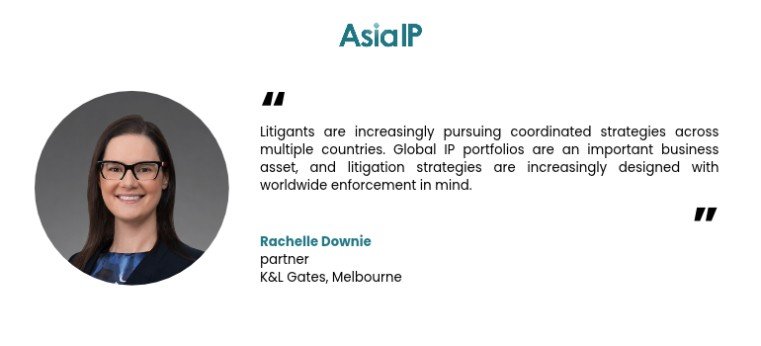
Another one of the main trends is the increased global nature of IP disputes, particularly in the context of patents. “Litigants are increasingly pursuing coordinated strategies across multiple countries, especially in sectors such as pharmaceuticals, biotechnology, telecommunications, technology and sport,” said Rachelle Downie, a partner at K&L Gates in Melbourne. “Global IP portfolios are an important business asset, and litigation strategies are increasingly designed with worldwide enforcement in mind.”
For example, in the patent space, the Unified Patent Court (UPC) has accelerated this trend by providing the availability of pan-European relief through a single proceeding. The UPC has increasingly exercised its long-arm jurisdiction allowing for cross-border patent enforcement in Europe for European patents. The UPC has already demonstrated its ability to reshape patent enforcement strategies, allowing patentees to use the UPC to leverage enforcement options across Europe.
The strategic use of forums is also notable in the telecommunications and technology sector, where fair, reasonable and non-discriminatory (FRAND) disputes are on the rise in the United Kingdom. “The English courts are increasingly being asked to determine the terms of global FRAND licences, demonstrating the strategic importance of the UK in global telecommunications patent disputes. The rise in FRAND disputes in the UK is likely to see increasing interaction, and perhaps tension, with overseas courts which also play a role in resolving FRAND disputes,” said Downie.
Another key trend is the growing value of trade secrets and confidential information. Downie said that advances in AI and data mobility are shifting the protection towards trade secrets litigation, particularly in the U.S., with some reports noting a 20 percent increase in trade secrets litigation.
In Australia, trade secrets are protected as a subtype of confidential information, and in recent years, there has been an uptick in the number of cases involving misuse of confidential information.
“From an Australian perspective, patent litigation remains active across a range of sectors,” Downie said. “Disputes are shifting towards achieving early wins though challenges to patent term extensions and via preliminary injunctions and expedited trials. Computer-implemented inventions and the validity of such patents continue to shape the patent litigation landscape in Australia. Brand protection disputes are also important in Australia, influenced by the rise in dupes and issues of the honest concurrent use of trademarks.”
In Indonesia, a particular case comes to mind regarding music copyright. The dispute began when composer Ari Bias sued Agnez Mo for performing his song without direct permission. A lower court initially ruled against the singer, raising concerns that performers might need permission from every songwriter.
The Supreme Court later overturned the decision, while the Constitutional Court clarified that commercial event organizers are responsible for paying royalties.
The dispute continued when Ari Bias filed a second lawsuit in 2025 against the event organizer, seeking Rp4.9 billion (US$297,000) in damages. However, the case was dismissed in June 2026 because the organizer was found to have no direct legal relationship with the event.
“One question has been answered, namely that commercial performance organizers are the party obliged to pay royalties. The next question, however, arises immediately. Within the chain running from venue owner to operator to promoter, who exactly counts as the organizer?” said Nugraha Bratakusumah, managing partner at Marklaw Legal Counsel in Jakarta.
AI and IP litigation
Artificial intelligence is already transforming IP litigation in multiple ways, such as becoming the subject matter of disputes. According to Yee, the courts are being asked to adjudicate disputes relating to the use of copyrighted works to train AI models, and to consider questions such as whether AI-generated works can qualify for copyright protection (for example, the amount of human involvement necessary to meet the requirements of authorship), and whether AI service providers or AI users should be responsible when AI-generated content infringes third-party IP rights.
She also added that AI is changing how disputes are conducted. “Technology-assisted review, predictive analytics and AI-powered document management tools are helping lawyers and litigants process vast quantities of data more efficiently,” she said. “Whilst these tools can improve efficiency, they also raise new questions regarding accuracy, transparency, confidentiality and evidentiary reliability.”
For Tatsuno, AI is not only generating new copyright disputes but expanding litigation into areas that have traditionally been less prominent within IP law.
One example, he noted, is the growing attention being paid to AI-generated voices, likenesses and digital replicas. “In Japan, recent disputes and policy discussions have focused on whether the unauthorized reproduction of a person’s voice using AI may infringe legally protected interests. A dispute involving the alleged use of an AI-generated version of a voice actor’s voice has attracted particular attention and reflects broader concerns regarding voice-cloning and deepfake technologies.”
“These disputes often involve multiple areas of law at the same time, including intellectual property, privacy and unfair competition law. As AI becomes increasingly capable of replicating human characteristics with a high degree of realism, courts will be required to determine how existing legal doctrines should apply.”
AI could also change the way courts handle disputes. “Recent media reports indicate that the Japanese courts are considering the introduction of AI-assisted technologies to support judicial operations. While these discussions remain at an early stage, they reflect a broader trend of judicial institutions exploring how technology can be used to improve efficiency in reviewing large volumes of documents and evidence,” said Tatsuno. “For IP disputes, which often involve significant amounts of digital evidence and technical materials, such developments may ultimately influence not only the substance of litigation but also its administration.”
In Australia, a human author is still required; copyright only subsists if it involves independent human intellectual effort. An AI system cannot be an author of a copyright work, and therefore copyright cannot subsist in an AI-generated work. The U.S. Copyright Office has generally taken a similar approach to the registrability of AI-generated works, although there is more room to move in the U.S. than in Australia. The U.S. Copyright Office has indicated that AI-created content may be protectable if there is sufficient human involvement and creativity.
On the other end of the spectrum, in China, an AI-generated work can be capable of protection by copyright provided there was sufficient human effort involved in prompting and the selection of parameter choices.
Downie said that the divergent global approach has commercial implications for businesses, creating different rights, enforcement options and opportunities. “There is also a growing number of cases examining whether AI-generated outputs infringe existing copyright,” she said. “The three main areas in which infringement questions have arisen relate to the training of AI, the output of AI and whether the AI model itself is a copy of copyrighted works. U.S. courts have increasingly been asked to consider questions of infringement, including in the context of fair and transformative use, with several high-profile litigations in the U.S.”
AI is also transforming legal and IP litigation practice. Generative AI tools are improving efficiencies and reducing costs, particularly in large global IP disputes. As in other contexts, the widespread adoption of AI introduces its own challenges around confidentiality, reliability and legal ethics.
Downie said: “Australian courts have adopted a sound and measured approach to the use of AI in IP disputes. For example, in April 2026, the Federal Court of Australia issued its Generative Artificial Intelligence Practice Note, which recognizes that AI can improve efficiency, reduce costs and assist in the conduct of litigation, while emphasizing that lawyers remain responsible for verifying the accuracy of all content submitted to the court. The Practice Note identifies that it is fundamental to the administration of justice that generative AI must be used appropriately, responsibly and with due care.”
Challenges in businesses
The challenge businesses must watch out for in IP today is the habit of using AI, said Bratakusumah. In Indonesia, a work must be created by a human and must be distinctive and personal. “Companies must therefore ensure that work produced with the help of AI genuinely proceeds from human thought, ideas and creative capacity rather than relying entirely on the machine. AI must be treated as a tool and not as an author. Honesty and ethics are an inseparable part of ensuring that a work was indeed created by a human.”
AI-generated logos may create trademark and copyright risks if they inadvertently draw from existing marks or copyrighted materials, while also raising fairness concerns when users claim exclusive rights over work they did not personally create – and this is where the misalignment lies, said Bratakusumah. “The Indonesian Copyright Law states that an author is a ‘person’, so that a work created by AI is not recognized as a work. The Trademark Law, however, knows no similar requirement. A mark generated with AI can still be registered and obtain the exclusive rights the state recognizes, if it is not similar in its essential part or in its entirety to a mark that is already registered or applied earlier.”
“The state ought to step in and regulate this issue so as to prevent and guard against such situations. In addition, every business needs to make an extra effort to build a firewall or other preventive system against the data mining carried out by AI tools. The threat that in my view is most often overlooked in fact comes from within, namely the leaking of a company's trade secrets through employees who upload confidential company data or documents to AI services. Indirectly, AI can record that data into its system and use it as a new source of information within its intelligence.”
The problem is not merely the leak, he noted, but the loss of legal protection itself. Article 3 of Law No. 30 of 2000 on Trade Secrets requires three cumulative elements, namely that the information is not known to the public, that it has economic value, and that its confidentiality is maintained through proper efforts.
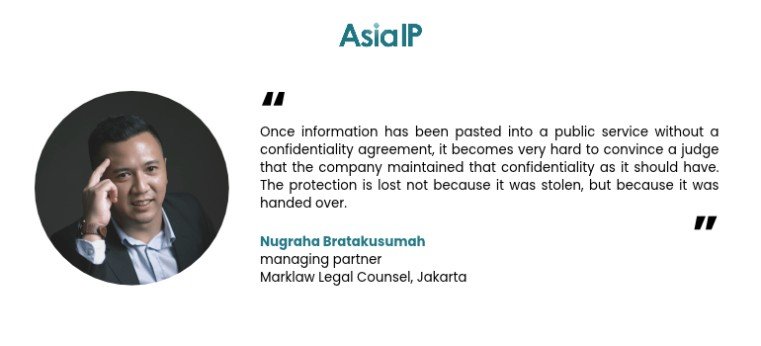
“It is the third element that collapses,” Bratakusumah said. “Once information has been pasted into a public service without a confidentiality agreement, it becomes very hard to convince a judge that the company maintained that confidentiality as it should have. The protection is lost not because it was stolen, but because it was handed over. Companies clearly need firm internal rules on this, so that employees do not readily surrender company data or documents to AI applications.”
“The next threat hides inside contracts and is usually recognized only when it is too late. Companies that buy logos, illustrations, copy or marketing material from creative vendors almost always include a copyright assignment clause. If the work turns out to have been produced entirely by AI, however, there is no copyright capable of being assigned, so that the clause becomes empty, and the company has paid for something it never received. An assignment clause on its own is therefore no longer sufficient. What is needed is a warranty from the vendor as to the degree of human involvement in the creative process, an obligation to disclose the use of AI, and an obligation to hand over a record of the creative process.”
IP litigation in the coming years
According to Tatsuno, a key issue will be how courts apply existing legal principles to technologies that are evolving much faster than the law. “The cases now moving through the courts are expected to clarify issues such as the permissible use of copyrighted works for AI training, the treatment of AI-generated outputs, and the level of transparency expected from AI developers. These decisions may have a lasting impact on the future development and commercialization of AI technologies.”
At the same time, disputes involving AI-generated voices, images and digital replicas are likely to become more common. “As technology continues to improve, courts and lawmakers will increasingly be asked to address questions concerning consent, ownership and liability,” he said.
“One of the biggest drivers of future disputes will be the growing divergence in how jurisdictions regulate AI and digital assets. Companies are increasingly operating globally, while AI laws are developing locally. That tension is likely to generate significant litigation and enforcement activity.”
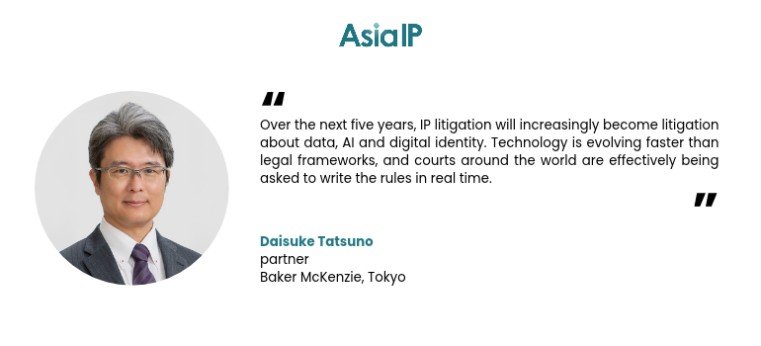
“In short, over the next five years, IP litigation will increasingly become litigation about data, AI and digital identity. Technology is evolving faster than legal frameworks, and courts around the world are effectively being asked to write the rules in real time,” he added.
According to Yee, the increasing sophistication and capabilities of AI models will continue to reshape everyday lives and the way businesses operate. “Questions surrounding AI training, authorship, ownership and liability are likely to persist and continue to generate significant litigation and legislative reform worldwide.”

“Geopolitical and trade considerations are likely to play a larger role in IP enforcement,” she added. “As countries seek to protect strategic industries and technological innovation, IP rights will become more closely intertwined with industrial policy, national competitiveness and cross-border commerce. Finally, we can expect greater recognition of intangible assets as a driver of economic value. As companies place increasing emphasis on technology, brands, content and data, disputes concerning ownership, commercialization and enforcement of those assets are likely to become more frequent and more complex.”