
IP 101 for bloggers, vloggers, livestreamers and podcasters
07 September 2026
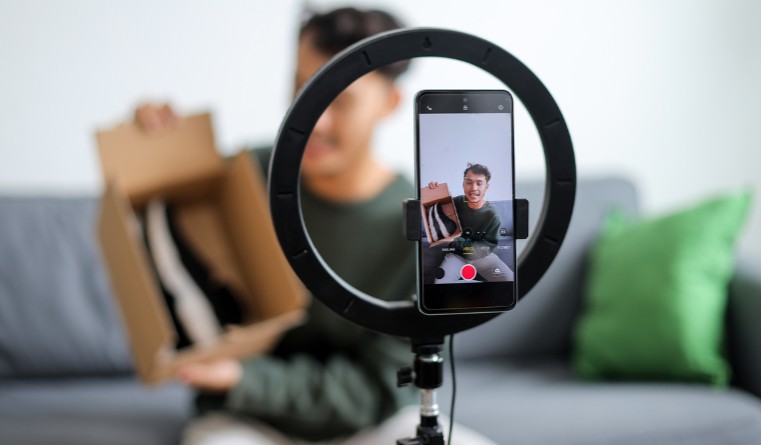
As Asia’s creative economy grows, intellectual property remains a blind spot for many influencers. Espie Angelica A. de Leon explains the risks, rights and best practices behind successful content creation.
Social media influencers are thriving in Asia. Bloggers writing restaurant reviews, vloggers showcasing day-in-the-life clips and food recipes, livestreamers at exotic travel destinations, celebrities giving beauty tips, fashion icons representing global brands, podcasters with educational, health and lifestyle-related content – the pool of content creators and influencers in the region is massive.
The list of Asian influencers is led by Blackpink’s Lisa herself, who boasts over 100 million followers on Instagram. It also includes Singapore’s Willabelle Ong, the Philippines’ Kathryn Bernardo, Indonesia’s Raffi Ahmad and Nagita Slavina, Thailand’s Sungstarwin and many more.
Are these content creators aware that their massive reach across multiple platforms has implications for intellectual property rights? Are they even knowledgeable about IP in the first place?
Influencers in Asia: Largely clueless about IP
The answer, it seems, is no.
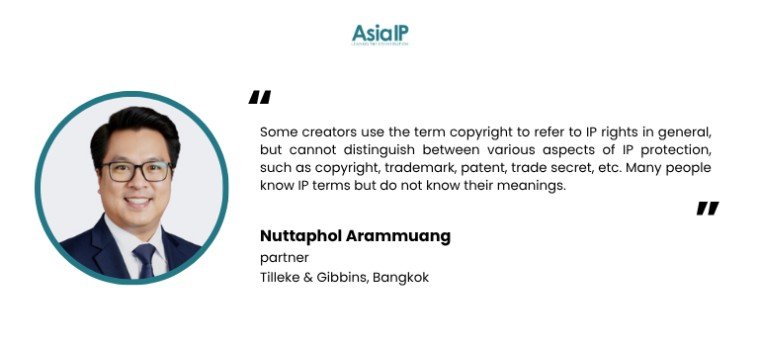
“Some creators, even media, use the term copyright to refer to IP rights in general. Hence, most of them cannot distinguish between various aspects of IP protection, such as copyright, trademark, patent, trade secrets, etc. Many people know IP terms – like fair use, exclusive right – but do not know their meanings,” says Nuttaphol Arammuang, a partner at Tilleke & Gibbins in Bangkok, referring to content creators in Thailand.
“There is a pervasive belief that if an image is easily searchable on Google, it is in the public domain and free to use. That is simply false,” added Arjel P. de Guzman, a partner at de Guzman Mayuga in Manila. “We also see a lot of frustration around music rights. Many don’t realize that buying a track on a streaming platform doesn’t give them a synchronization licence to legally use that music as background audio in a sponsored vlog.”
Globally, the Philippines is a mecca for content creators. According to the Digital 2025 report by online media, social and consumer intelligence company Meltwater and social media and influencer marketing expert WeAreSocial, the Philippines topped the chart for weekly vlog and influencer video consumption worldwide with almost half of Filipino netizens watching vlogs each week. The country likewise took the number one spot when it comes to following influencers on social media and also ranked number two in watching how-to, tutorial and educational videos every week.
Meanwhile, India is home to over 80 million content creators and an influencer marketing industry estimated to reach Rs33.75 billion (US$350 million) by 2026.
“Larger, more commercialized creators, particularly those with management agencies or legal counsel, tend to have a working understanding of copyright and contractual terms. It is the long tail of mid-tier and nano-influencers who operate in a legal vacuum,” revealed Harsha Aswani, a senior associate at Khurana & Khurana in Noida. These mid-tier and nano-influencers number in the millions.
Through November 2025, 1,409 influencer violations were processed by the Advertising Standards Council of India (ASCI). Of these, 94 percent involved disclosure failures.
For Aswani, this is a staggering statistic. “Disclosure is the most elementary compliance obligation a creator carries, one that requires no legal expertise, only reading and following published guidelines. If creators are struggling at that baseline, the depth of unfamiliarity with more demanding IP concepts is predictable and documented. The high volume of copyright takedown disputes, the regularity with which creators assign away their rights in collaboration agreements without understanding what they have signed, and the relative rarity of trademark registrations among mid-tier and nano-influencers all point in the same direction: IP literacy in the creator economy is not merely low, it is structurally absent for the majority.”
A similar knowledge gap exists in South Korea. Top-tier influencers often tap legal counsel to vet their content prior to publication. However, their younger counterparts, some of whom are students working as part-time content creators, are less aware of the legalities.
“With the barrier to entry lower than ever, there is a massive surge of student creators ranging from elementary to high school, who frequently engage in ‘secondary creation’ or ‘edit culture.’ These younger demographics often operate under the misconception that editing someone else’s video or using a trending background track on social media is inherently harmless,” related Dong-Won Kim, an attorney at Kim & Chang in Seoul.
Meanwhile, the growing use of artificial intelligence in content creation has further increased uncertainty regarding ownership, infringement and ethical responsibilities in Vietnam, according to Hung Nguyen Tuan, a patent examiner at NaciLaw in Hanoi.
The basics of IP for influencers
First, influencers should be familiar with the two basic IP rights associated with the content they create and put out online.
First is copyright. Any artistic or creative work is protected by copyright. “A travel vlog, a food blog, an original podcast, a curated reel, all attract copyright protection automatically. The creator has the exclusive right to reproduce, distribute, publicly perform and create derivative works,” said Aswani.
Copyright vests in the creator from the moment of creation of the artistic work.
Copyright laws also make room for “statutory fair use” or “fair dealing” of copyrighted content for news reporting, education, commentary, reviews and criticism.
“However, many vloggers mistakenly believe that reacting to a movie or making a meme automatically qualifies as fair use. It is highly contextual. Courts look at four factors, including the purpose of the use. Is it commercial, and how much of the original work was taken?” said de Guzman.
So, where does one draw the line between legitimate criticism using short news clips and copyright infringement? According to Aswani, this is the most pressing question faced by India’s digital creators today.
She cited ANI Media v. Mohak Mangal and Ors. (2025). The case involved YouTube personality Mohak Mangal, who is known for political commentary. Mangal used short footage from Asian News International (ANI) Media to provide his comments on the news agency’s reporting. ANI, South Asia’s premier multimedia news organization, slapped Mangal with copyright takedown notices and a lawsuit. In May 2025, the Delhi High Court ordered Mangal to remove specific language from his commentary, which the court found defamatory. However, Justice Amit Bansal declined to restrain the commentary video altogether.
“The substantive copyright question under Section 52 of the Copyright Act, 1957 remains to be adjudicated. This case is essential reading for every creator who uses news clips in commentary. Fair dealing for criticism and review is a recognized defence, but it has boundaries, and the process of establishing those boundaries is expensive and slow,” Aswani said.
Influencers must also be aware that a mere idea cannot be protected by copyright. What may be protected is the original expression of the idea.
Aswani mentioned another case, Humans of Bombay Stories v. POI Social Media, to illustrate this. Storytelling platform Humans of Bombay sued People of India, another storytelling platform, for using its commissioned images, videos and written content without permission. The Delhi High Court prohibited both platforms from using each other’s content. It also held that neither Humans of Bombay nor People of India can operate as a storytelling platform and claim monopoly over the idea of functioning as such. “The court drew a clear distinction between an idea, which is not protectable, and its original expression, which is. That distinction should resonate with every content creator who believes that copying a format or style is legally safe. It is not,” noted Aswani, “once the copying extends to specific original expression.”
The second IP right associated with content creation is trademark. It goes hand in hand with brand protection. Trademarks come in multiple forms: the identity of the influencer, a vlogger’s channel name, podcast name, logo, social media handle, online course name, tagline, virtual avatar, signature, even the influencer’s distinctive catchphrase, if any.
“These identifiers distinguish an influencer from competitors and help audiences recognize the source of content and services. From these trademarks, celebrities and influencers can develop content, videos and clips to attract viewers and listeners, thereby benefiting from them,” said Nguyen.
Copyright and trademark are the two primary IP rights that content creators and influencers must know about – but it doesn’t stop there. They must also be conscious about IP and personality rights and how AI impacts these.
In June 2025, international headlines reported a groundbreaking development in Denmark: Legislators were proposing amendments to the Danish digital copyright law. The amendments seek to stop the creation and sharing of AI-generated deepfakes featuring the likeness of individuals, including their voice, without their consent. In short, the lawmakers wanted Danish people to have copyright over their own image, facial features and voice to combat the growing threat of deepfakes. The draft law was available to the public for comments until February 2026.
Aswani says that courts in India have increasingly recognized that a person’s name, image, likeness and voice constitute protectable personality rights, drawing principally from Article 21 of the Constitution.
For her, the intersection of AI and IP is the defining legal challenge for content creators in the next decade. “Creators face a two-sided risk,” she explained. “On one side, their own voices, faces and content are being used without consent to train AI models and to generate deepfakes. On the other side, creators who use AI-generation tools must be alert to the possibility that the output infringes third-party copyright embedded in the training data.”
To-do list for content creators:
These are the steps that bloggers, vloggers, livestreamers, podcasters and other content creators must take to protect their IP assets:
- Identify your IP assets.
- Develop an IP protection strategy.
- Conduct trademark clearance searches, then file applications for trademark registration.
According to Aswani, professional influencers, most of whom operate as a business, must treat their personal brand as a trademark asset from the outset.
Hence, registration is a must to prevent trademark infringement. It prevents other parties including competitors from registering similar marks. One podcaster may use another more famous podcaster’s channel name and apply for trademark registration. Since the channel names are similar, viewers are wont to believe it is the same digital program, or is somehow affiliated with the original podcast. Under this scenario, the famous podcaster will have no option but to rename or delete his channel altogether.
Trademark registration also prevents unauthorized merchandise sellers from peddling products carrying marks associated with an influencer, such as the image, vlog title or catchphrase of an influential vlogger.
In the event of trademark infringement without registration, a content creator can invoke the passing-off remedy, especially if he has built significant goodwill. The problem with passing-off is that litigation is far more uncertain and expensive.
- Register your copyright.
Registration is not mandatory, but it is highly encouraged to publicly record ownership and strengthen enforcement of the right.
- Draft licensing agreements.
- Read those sponsorship and endorsement contracts carefully before signing.
In connection with copyright and trademark, influencers must also be aware of their contractual rights and ownership in collaborations.
In an employer-employee arrangement where a work is created by the latter in the course of his employment, copyright laws confer ownership to the employer.
However, if the creator of the artistic work acts as an independent contractor, copyright generally remains with the creator unless a contract or written agreement states otherwise and assigns copyright ownership to the party who hired the contractor.
De Guzman explained: “If a brand hires an influencer to shoot a campaign, the creator needs to pay close attention to their contracts. Depending on the wording, the brand and not the creator might own the final copyright as a ‘commissioned work.’”
“Frequently, creators sign away their rights without realizing it,” Aswani added.
“Creators must therefore resist blanket assignment clauses and negotiate the scope, duration and territory of any licence or assignment in every brand collaboration agreement,” Aswani advised.
- Assess infringement risks.
- Build a long-term IP portfolio that supports business growth and monetization.
- Include an IP attorney in your team.
“Just as successful businesses rely on accountants, financial advisors and marketing specialists, professional influencers should consider IP attorneys and trademark professionals as important members of their long-term business support team. Many creators and influencers mistakenly wait until a dispute arises before seeking legal assistance,” said Nguyen.
A legal professional on the team can assist influencers during each of the steps mentioned above to better protect their IP assets and strengthen enforcement against infringers.
“The cost of legal counsel is modest relative to the commercial value at stake and the cost of litigation,” reminded Aswani.
There are two sides to the coin. One side is all about bloggers, vloggers, livestreamers and podcasters protecting their IP assets. The flip side? The very same influencers who own copyrights and trademarks may also be the ones infringing another creator’s IP rights, though inadvertently.
“In the digital ecosystem, creators frequently use existing music, video clips, images and written text to enhance their own content. Under South Korea’s copyright act, using even a brief snippet of another person’s work without a proper licence, unless it satisfies the legal requirements of fair use, can constitute copyright infringement. Many creators mistakenly believe that adding a simple disclaimer such as ‘No copyright infringement intended’ or ‘Credit to the owner’ grants them legal immunity, which is not correct,” said Kim.
“Furthermore, the ever-present trend of remix culture compounds this problem, as online platforms such as TikTok encourage influencers and content creators to create content that features or incorporates others’ work in some capacity to hop on viral trends,” added Arammuang.
Thus, a basic rule of thumb for influencers is to verify ownership of any piece of work they intend to use for their own content – whether this is an image or photograph, video footage, text or music. They must obtain appropriate authorization or licences before using, reposting, modifying, promoting or monetizing content created by others. Failure to obtain authorization may lead to allegations of copyright infringement, trademark infringement, unfair competition, false endorsement, counterfeiting violations, copyright takedown notices, account suspension and worse, civil litigation.
“A single copyright strike on YouTube can result in demonetization, reduced reach, disruption of sponsorship arrangements and material revenue loss. The financial and reputational stakes are real,” Aswani warned.
Kim suggested that content creators who are looking for safe sources for their materials use public domain works and government-backed open databases. One of these is the “Public Works” (공공저작물) database by the South Korean government. It contains a huge collection of images, videos, music and fonts – all cleared for public use, thus are safe for content creators to utilize.
“However, from a legal standpoint, I must advise creators to always verify the specific KOGL (Korean Open Government Licence) type attached to each work. While Type 1 allows for commercial use and the creation of derivative works with simple attribution, Types 2-4 may strictly prohibit commercial monetization or modifications,” Kim said.
For more information about IP, content creators only need to look at four basic sources: IP organizations such as WIPO, IP offices, law firms and legal publications.
IP offices’ websites provide useful information including IP laws and case reports in various formats such as articles, explainer series, guidelines, FAQs, e-learning, online courses and others.
Influencers will also learn about IP from reading the IP guidelines and policies of their chosen platform, instead of merely clicking through the terms of service.
Joining creator communities focused on digital rights is also a great idea. According to de Guzman, this is the best way to dismantle the harmful myths that get young vloggers into legal trouble.
Content creators come from all age groups. Because of this, Kim believes education must be multi-layered, combining formal schooling with public and platform-driven initiatives. “Looking at the long term, this foundation must be integrated into primary and secondary school curricula. Basic IP literacy and digital ethics are currently being introduced in some schools, but this needs to be universal. Teaching students how to respect original creators should be a mandatory component of standard digital literacy education,” he said.