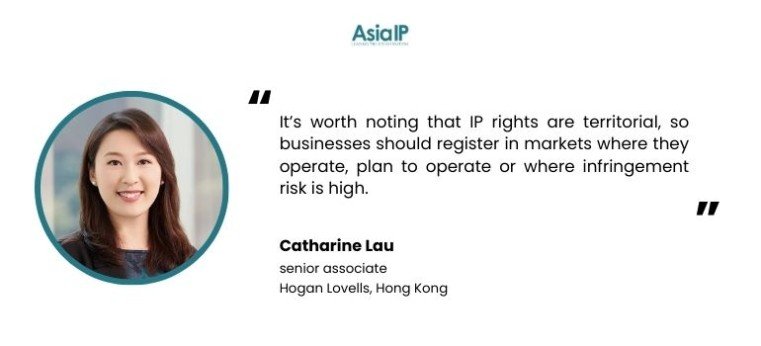
“It’s worth noting that IP rights are territorial,” Lau reminded, “so businesses should register in markets where they operate, plan to operate or where infringement risk is high.”
In some jurisdictions, business owners may also record IP rights with customs authorities to prevent the importation of counterfeit goods.
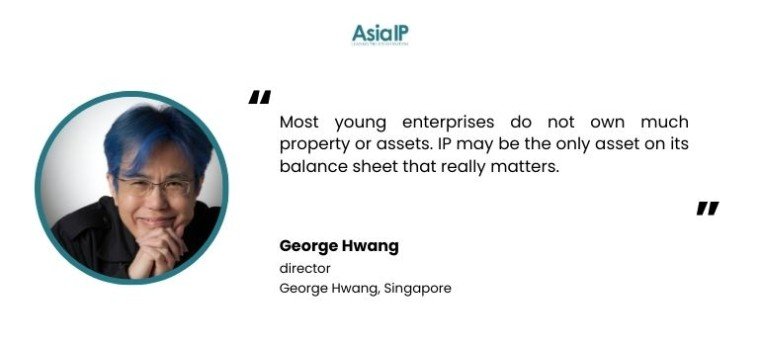
But first, start-up owners must consider their budgets. “For certain IP, such as patents and registrable designs, we may have to consider the registration from an international perspective from the start. The requirement of ‘novelty’ for patenting is often assessed against a global state of the art, not just within the jurisdiction where the application is filed. Therefore, we should take advantage of the international filing system which could yield a substantial sum in savings,” Hwang pointed out.
As for trademarks, Hwang said registration may be timed a step before entering a market, as applicants don’t have to register the trademarks in all possible markets “in one go.” Instead, they can register the marks in stages, depending on the schedule for launching the product or the uses of the mark. Again, budget plays a role here. He explained: “Unlike patents, trademark registration does not have the requirement of novelty for the science and technology for which the applicant is seeking a monopoly. Most countries these days require that this novelty be on a worldwide basis. Whilst trademark registrations could be defeated by a similar prior registered mark, this criteria is based on a country-by-country basis. Therefore, for a company with a tight budget, we can sync our trademark registrations with the overseas marketing plans of the owner.”
But there’s a danger. The IP owner may lose their trademarks to some local operators. IKEA and Polo Ralph Lauren are some examples. Both marks have faced legal challenges in Indonesia with regard to their trademarks. In July 2024, Ralph Lauren issued a public statement announcing that it has nothing to do with certain Indonesian companies that legally own similar marks, such as PT Manggala Putra Perkasa, which owns the T-shirt brand Polo by Ralph Lauren.
The statement read: “We would like to clarify that this company is not affiliated with or related to Ralph Lauren in any way and that these disputes do not involve Ralph Lauren. Ralph Lauren currently does not directly operate any stores in Indonesia, nor has it authorized or entered into an agreement with any partner or distributor to operate any ‘Polo Ralph Lauren’ or other ‘Ralph Lauren’ branded store in Indonesia.” PT Manggala was involved in disputes involving the trademark.
Set up an IP asset register or catalogue
Another key measure is to maintain an IP asset register or a catalogue. This will enable the organization to track renewal deadlines, patent maintenance fees and other important details which IP owners should be reminded of regularly. Hwang suggested including the revenue generated and attributable to the different IP assets in the register.
Begin monitoring
Once the IP assets are registered, the company must begin monitoring the market, online platforms and competitor activities for potential infringement. “If infringement occurs, it may be necessary to send a cease-and-desist letter or consider other steps, such as taking legal action. If the infringement is on online platforms, consider requesting takedowns,” Lau advised.
Have agreements in place
It is important to have proper agreements, including non-disclosure agreements with employees, contractors, freelancers and partners, stating that the company owns all IP created for the business.
“All businesses start with an idea. Identify what it is and have the ownership transferred to the company. If there is a patentable invention, it is wise to have ownership in the confidential information relating to the invention assigned to the company, too. This should include information which is incidental to the invention, even if not patentable. Very often, the know-how for producing a patented product may be just as important as the patent itself,” Hwang disclosed.
According to him, documents with other founders, employees and most especially contractors should clearly facilitate this transfer of ownership. “We are in a ‘gig’ economy. There are many talented digital nomads, especially in the tech sphere. You may contract with a software developer living in Bali. Six months after finishing the project, he could have moved to Peru or scaled the Mayan ruins in Guatemala, somewhere difficult to locate. If you have a legal assignment which is imperfect, you may have to wait for six months before he answers your email, by which time your investor may have lost interest in your company,” Hwang noted.
Implement internal policies
These policies will help protect sensitive business information including the company’s trade secrets.
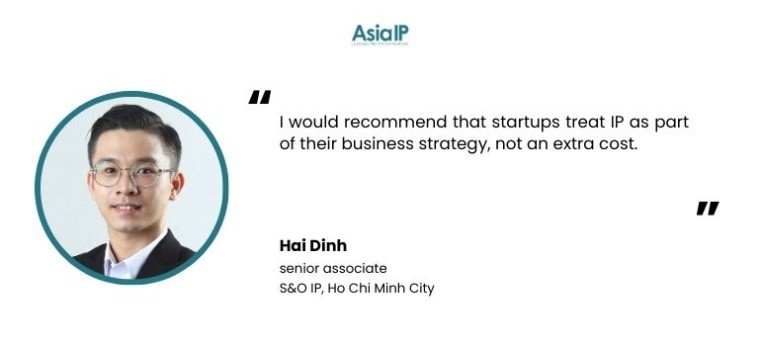
“You can limit access to sensitive information on a need-to-know basis, as well as implement robust cybersecurity measures to protect digital assets,” Dinh said.
“These days, much information is stored in third-party platforms such as GitHub. Find out about their security measures and check your subscription agreement,” Hwang added.
Develop an IP strategy
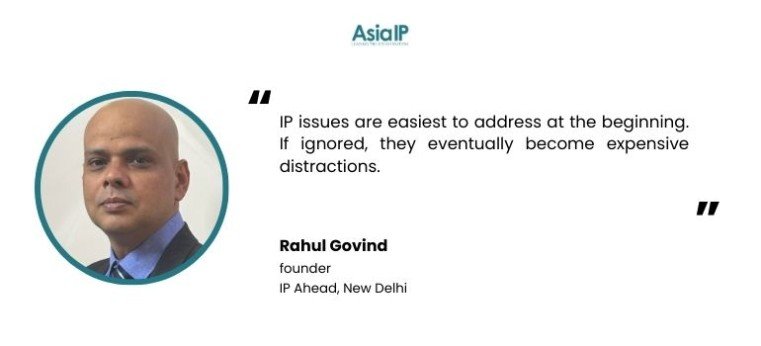
Another key step is to create an IP strategy. Ideally, this should be done in the first few weeks. “It does not have to be complex – identify protectable assets, secure ownership, file key trademarks and maintain confidentiality over proprietary information,” Govind shared.
Employee training
Startup owners should encourage training initiatives for their employees to educate them about IP rights and the importance of IP protection. “Many employees may not fully understand what constitutes IP or why it is critical to the organization’s success. Training programs can help clarify these concepts and highlight the potential consequences of IP breaches. Use case studies or examples of IP breaches to illustrate the potential consequences of mishandling sensitive information. This makes the training more relatable and impactful,” Dinh suggested.
As new business owners navigate these IP matters including the law, they must seek professional advice to ensure their assets are fully protected. They must do so from the very beginning. “Additionally, by getting adequate and professional advice at the very beginning, businesses can avoid potential refusal or office action by the authorities or legal risks that come from earlier registered IP rights, which could be a time-consuming and costly process for a new established business and even potentially and negatively affect their business plan,” Dinh said.
Hwang emphasized the value of seeking professional advice before applying for IP registration. He says that a lot of startup owners try to save costs by getting their IPs registered and preparing contracts on their own. “Not only have I witnessed badly drafted assignments and contracts that need re-drafting,” he revealed, “I have also seen trademark registrations that were a waste of money.” He related an instance when they were not able to sue for trademark infringement because the part of the mark registered was a design that was complicated, but generic. It was so generic that no consumer with an imperfect recollection would remember it. Meanwhile, other aspects of the brand which may be simpler yet more memorable, were not registered at all. These elements can be easily copied and have indeed been copied. “As a result, we had to rely on the more difficult path of passing off,” Hwang said.
“Similarly, we were not able to obtain monetary compensation duly belonging to our client for an infringement of a registered design even though the manner in which the design was registered was nearly perfect,” he added. “This is because its registration number was not affixed on the product or its packaging.”
Other mistakes they encountered include premature disclosure of confidential and novel elements of a patentable invention in the case of a startup that is very eager to market its products.
Hwang said that while a lot of information is available on the internet, most of it is for general understanding. One has to be trained to interpret the practical significance and how to implement this information. Hence, seeking professional advice in order to navigate through the process of IP registration is critical.
Professional advice also comes in handy when conducting market research. “For patents, for example, you may want to obtain a freedom-to-operate opinion. Similarly, an equivalent for trademarks,” Hwang shared. Doing these will help prevent disputes, rebranding costs and legal obstacles. Getting entangled with IP infringement issues later on will always be more expensive.
All businesses have IP. But not all business owners recognize the value of IP. This is unfortunate because IP is just as important as product development, marketing, funding and other stuff that occupy the mind of someone planning to establish his own business enterprise. IP, therefore, should never be overlooked. Instead, it must be top of mind.