Intellectual property: A gaping hole in financial reports

07 January 2026

Intellectual property: A gaping hole in financial reports

Despite driving much of modern economic value, IP remains largely absent from financial statements for several reasons. Espie Angelica A. de Leon probes how to bring these hidden assets into view. 


The dark matter of the modern economy – invisible, unknown, but exerting an increasing force on everything. 

In the exact words of Daren Tang, director general of the World Intellectual Property Organization (WIPO), this is what intangible assets, including intellectual property, are to him. According to Tang, the shift away from tangible assets to intangibles is one of the most profound economic changes of our time, fundamentally reshaping value creation. 

Yet, IP remains a gaping hole in financial reports. Business enterprises are excluding the value of their IP assets in their balance sheets and financial statements. IPs that are acquired do get recognized as assets, alright. But internally generated IP? More often than not, these are cast aside in finance reporting. So overall, IP is either under-reported or not being reported at all. 

As the write-up for the IP Finance Dialogue on WIPO’s website reads: “The ability to effectively leverage intangible assets, particularly intellectual property for financing, is becoming increasingly important for modern enterprises seeking growth and investment. However, challenges remain in how these assets are recognized, valued and disclosed.” 

What are the reasons for this under-reporting of IP? How can this hole be plugged? 
 

Why IP is a no-show in finance reporting 

Before we answer these two questions, a third question begs to be asked: What is this “everything” that intangibles – the so-called dark matter – are exerting an increasing force on, as Tang stated?  

Consider these: 

According to WIPO’s World Intangible Investment Highlights 2025, investment in intangible assets such as software, data, research and development (R&D), brands, design and organizational capital amounted to US$7.6 trillion across major economies and emerging ones such as Brazil and India. This worldwide growth in investments in intangibles has outpaced physical investment by a factor of 3.7 since 2008. In 2024, in particular, investments in intangible assets exceeded physical investments by 3 percent despite less than favourable economic conditions. 

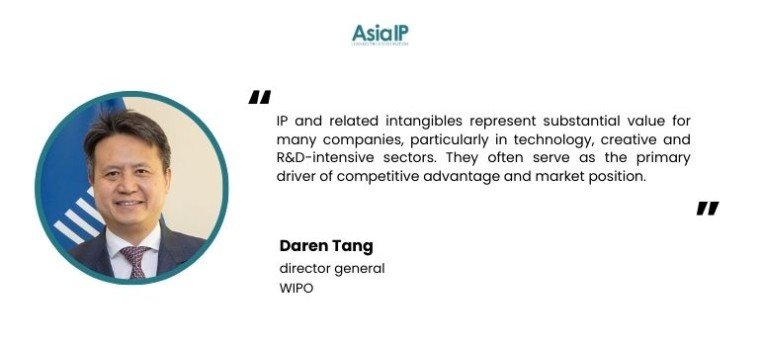
“IP and related intangibles represent substantial value for many companies, particularly in technology, creative and R&D-intensive sectors. They often serve as the primary driver of competitive advantage and market position,” Tang told Asia IP

“In the current economy, ideas aren’t just tools – they’re the engines,” said Ankita Sabharwal, a senior associate at Chadha & Chadha in New Delhi. “IP sits at the heart of what gives many modern businesses their edge. A patent can unlock a market. A trade secret can protect decades of research. A well-managed brand can build trust faster than a balance sheet ever could.” 

Tang revealed IP financing has been a priority of his administration. WIPO has been developing action plans and hosting global dialogues. One such dialogue was the IP Finance Dialogue held on May 13, 2025. WIPO, under Tang’s administration, has also been supporting small and medium-sized enterprises (SMEs) and providing educational resources to transform IP financing from a niche concept into a mainstream strategy for fostering innovation and economic growth.  

“This is a central part of WIPO’s vision where IP is seen as a catalyst for growth and development for all and not just about technical laws and regulations. It is about jobs, investments and support for entrepreneurs and SMEs,” Tang said.  

The good news, according to Tang, is that IP financing is now gaining prominence. Thanks to IP’s increasing economic importance, evolving financing needs and advancements in valuation methodologies. 
 

The under-reporting of IP 

“I believe the lack of reporting can primarily be attributed to the lack of knowledge of the importance of IP in finance. IP, in a general sense, has always been viewed as a legal asset rather than a combination of legal and financial assets for a business,” said Kangan Roda, a partner at illuminIP in New Delhi. “In some cases, businesses even may be unaware of their IP and the potential that it may have.” 

Deanna Wong, owner of DeLab Consulting in Hong Kong, agreed with Roda. “There is a lack of widespread discussion in the area,” she said, “especially in Asia.” 

Another reason for IP’s absence in financial reports is the lack of regulatory or mandatory IP disclosure requirements. 

The problem also lies in standard accounting itself. “Traditional accounting was built for an age where value resided in factories and inventory – assets you could touch, count and verify,” Tang explained. 

“IP, especially when created internally, doesn’t slot easily into those systems,” Sabharwal pointed out. “It doesn’t always have a defined cost; its future income is uncertain, and its value often depends on context, not just ownership. A trademark might be invaluable to one business and virtually meaningless to another.” 

According to Wong, the strict requirements such as identifiability, separability and reliable measurements cause professional service providers and accounting rules to be resistant to change, thus preventing the recognition of intangible assets. “[This is] because there are no real standards or objective methods to provide fixed valuation, even if certified evaluators are used. Further, as secondary markets for IP assets are often subjective, at times inactive, it means it is difficult to assign consistent or reliable monetary value to intangibles,” Wong explained. 

Because of this variability, regulators and auditors have traditionally hesitated to include internally generated IP on balance sheets, thus leaving out a substantial portion of corporate value in financial reporting. Oftentimes, this portion is the most important. 

Additionally, the under-reporting of IP may also be attributed to the highly sensitive nature of the subject matter in competitive industries. Disclosing IP information may lead to risks.  

How then should this gaping hole in financial reports be plugged? 

According to Sabharwal, accounting standards should first evolve to accommodate IP and other intangible assets. “The reality is that not all valuable assets are bought or built in a factory,” she remarked.  

She added that the International Accounting Standards Board, Financial Accounting Standards Board and other such institutions must work towards guidance that allows internally developed IP to be reported. Ownership, commercial potential and reliability of valuation must be established in such reporting. 

The International Valuation Standards Council and other internationally recognized bodies must also help develop more adaptive and sector-specific frameworks. 

“Uniform formulas don’t work across the board. What holds for a copyright in the media industry might not work for a semiconductor patent,” Sabharwal explained. 

“Accurate and standardized IP valuation would do more than merely satisfy the requirements or compliance for IP finance,” Roda noted. “It would also fundamentally change the outlook of a business towards the metrics of competition within the industry.” 

Changes must also be instituted internally. Regular tracking, auditing and maintenance of IP, as with any other critical asset, must be done to facilitate quantifying the value of the IP. A centralized intangible asset register will be very useful in this regard. “[This will] signal to investors and regulators that the company is taking a disciplined, forward-looking approach to managing its innovation capital,” Sabharwal said. 

Enhanced disclosure of IP is another positive, and practical at the same time, step toward achieving the goal. This may take the shape of structured supplementary reporting that provides valuable insights. “While recognition in the primary financial statements may not always be appropriate or feasible, supplementary disclosures offer a practical solution. Integrated reports, explanatory notes on IP and enhanced management commentaries also provide structured ways to communicate the strategic importance and value of IP assets,” Tang advised. 

“[We should also have] more international benchmarking databases, license pricing databases and objective methods for certified valuators to base their valuations on,” Wong said. 

And finally, education. Small and medium-sized enterprises including business start-ups must be educated on the benefits of reporting IP holdings. They must also be guided toward realizing the full potential of their innovation and brand assets. 

“Aligning financial reporting with IP assets should not just be a regulatory preference,” Wong emphasized, “but at times a strategic imperative.” 

Indeed, the inclusion of IP in balance sheets and financial statements does have real impacts: It provides a more accurate representation of the business’ innovation history as well as brand assets; sharpens business valuation; strengthens credit worthiness; demonstrates a company’s serious resolve to keep on innovating; improves decision making by capital markets, investors and financiers which allows greater access to IP-backed financing and continued innovation by enterprises; facilitates assessment by business leaders of which intangible assets are pulling their weight and which are under-leveraged; improves the company’s negotiating powers; provides higher mergers and acquisitions or related spin-off opportunities and tax benefits. 

“Even in the case of IP disputes, sales or licensing dealings, accounted IP would make payment negotiations straightforward and would save time for all involved,” Roda added.  

Down the line, IP’s representation in balance sheets and financial statements is poised to drive growth in an economy increasingly focused on knowledge and innovation. 

Fortunately, progress is taking place among accounting standard-setters who are exploring how intangibles are reported. “The path forward is promising,” Tang affirmed. “As enhanced information on IP and intangible assets becomes the norm, this will inform future accounting standards revisions and updates and drive continuous improvement in how we measure and communicate value. This evolution benefits everyone.” 

Roda is as optimistic. “In my opinion, within the next few years, we will witness the rise of IP valuation and see the term brand value truly get a secondary meaning,” she declared. 


Law firms

Please wait while the page is loading...

loader