

Trademark prosecution strategy in the Philippines
28 September 2026

The objective of trademark registration is not merely to obtain registration as quickly as possible, say Editha R. Hechanova and Joy Marie G. Tolentino. It is to develop a trademark portfolio in which the marks are registrable, protectable, commercially useful and capable of supporting the business as it grows. As such, they say, trademark prosecution should begin with the end in mind.
Trademark prosecution is sometimes viewed as a straightforward administrative exercise: select a mark, file an application, respond to any objections and wait for registration. In practice, however, an effective trademark prosecution strategy begins well before an application reaches the Intellectual Property Office of the Philippines (IPOPHL). Every decision made at the early stages – how a mark is selected, how thoroughly it is searched, how the goods and services are described and even whether the application is filed as a word mark or a composite mark – can affect not only the likelihood of registration but also the eventual strength and commercial usefulness of the resulting trademark right.
The governing law for trademarks prosecution is RA 8293 and its implementing rules (IP Code) which defines a mark as “any visible sign capable of distinguishing the goods (trademark) or services (service mark) of an enterprise and shall include a stamped or marked container of goods.” The IP Code proscribes the registration of marks that are contrary to public order or morality, confusingly similar to earlier marks, generic, customary, misleading, and descriptive marks subject to certain exceptions.
Thus, trademark prosecution should be approached not simply as a filing exercise, but as a process of risk identification and risk management. The objective is not merely to secure an early filing date under the first-to-file system, but to see the application through to registration and obtain protection for a commercially valuable brand – one that can withstand examination objections and third-party oppositions and ultimately serve as a strong and reliable source identifier for the owner’s business.
Start with a search, not with an application
One of the most important – and sometimes neglected – steps in trademark prosecution is the availability or clearance search. A business owner may already have invested considerable resources in developing and promoting a particular brand. Packaging may have been designed, domain names acquired, advertising materials prepared and products scheduled for launch, only to find out after filing the application that a similar earlier trademark exists, making the registration process more difficult and expensive than conducting a proper search at the outset.
A trademark search considering spelling variations, phonetic equivalents, abbreviations, translations, transliterations, dominant words and marks containing substantially similar components can prove particularly useful in identifying potential conflicts at an early stage. The search should likewise extend beyond the exact Nice Classification in which the applicant intends to file. Different classes do not necessarily mean unrelated goods or services. Goods may still be considered commercially related because of their nature, purpose, channels of trade, intended consumers, or manner of marketing.
Choosing the trademark: Think beyond registrability
The easiest trademark to market is not always the easiest trademark to register. Businesses naturally gravitate toward marks that immediately communicate something about their product. A company selling fast delivery services, for example, may prefer a mark suggesting speed. A skincare company may want a name suggesting beauty, clarity or protection. From a marketing standpoint, these choices are understandable. From a trademark standpoint, however, generic marks and highly descriptive marks can be difficult to register and even more difficult to enforce. In the case of Entourage IP Holdings LLC v. Director, Bureau of Trademarks, decided on appeal by the Office of the Director General in December 2023, the ODG held that the true test as to whether the words employed are descriptive of the article designated, but whether in them, the words as they are commonly used by those who understand their meaning, they are reasonably indicative and descriptive of the thing intended, and therefore, cannot be appropriated from general use and become exclusive property of anyone. In this case, Entourage applied for the registration of the mark “Georgia Peach” for alcoholic beverages and other related drinks. The trademark examiner and the Director of the Bureau of Trademarks (BOT) rejected the application on the ground that the mark is descriptive as it refers to a fruity peach cocktail with peach schnapps, rum and cranberry juice. The applicant argued that the “Georgia Peach” mark does not convey the information that it is an alcoholic beverage, and the appropriate test is not whether the trademark examiner views the mark as descriptive based on his research, but what the public with no information about the mark would conclude that it is an alcoholic beverage.
On appeal by Entourage, the ODG affirmed the rejection of the BOT and further held that the term “Georgia” can be considered as the name of a state in the United States or a country located in Eastern Europe and West Asia, and is therefore, a geographical name and cannot be appropriated exclusively by the applicant, Entourage.
Filing: In a first-to-file system, timing matters
Once the mark has been cleared and selected, prompt filing should follow. The Philippines adheres to the first-to-file system, making the filing date critical when competing parties seek rights over identical or confusingly similar marks. Under the IP Code, ownership of a mark is acquired by registration and the applicant who first files the trademark application usually prevails over other applicants or users. This was illustrated recently in the opposition case of Kempinski AG v. Gluck Resources Marketing Corporation, a Philippine company, decided by the ODG on June 25, 2026, involving the stylized “K” letter. The contending marks cover identical services, e.g., hotel services and other related services, and are shown below:
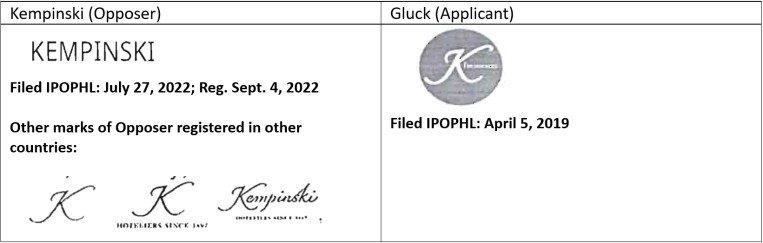
Kempinski claimed that Gluck’s stylized “K” is confusingly similar to its mark, and is well-known internationally because of its long history of existence and use since 1897, and has worldwide registrations for its marks, coupled with significant investments in advertising and promotions. The ODG affirmed the decisions of the Bureau of Legal Affairs dismissing the opposition, on the following grounds: (i) Kempinski failed to prove that its registered marks in other countries were well-known internationally and in the Philippines, and (ii) confusion is only possible when the goods or services covered by the allegedly similar marks are identical, similar or related and to be regarded as likely to deceive or cause confusion upon the purchasing public the prospective mark (in this case Gluck’s “K Residences”) must be shown to meet two minimum conditions, namely: (1) the prospective mark must nearly resemble or be similar to an earlier mark, and (2) the prospective mark must pertain to goods or services that are identical, similar or related to the goods or services represented by the earlier mark. The problem in this case, is that Gluck is the earlier mark.
Using the mark
Filing is only the beginning. Applicants must docket subsequent deadlines, particularly the required Declarations of Actual Use (DAU), since failure to comply may result in refusal of the application or removal of the registration from the Register. Trademark rights must be maintained through continued compliance with the requirements of the law. Accordingly, applicants should limit the specification to goods and services for which actual use can later be established through the required DAU, thereby helping preserve the registration and ensure the mark’s continuous protection.
Responding to an office action: Diagnose before you argue
An office action should not automatically trigger a lengthy legal argument. The first task is to determine precisely what problem the examiner has identified and what solution best serves the applicant’s commercial objective. The Trademark Rules require the examiner to include in the first office action all grounds for objection existing at that time. Piecemeal action is not allowed. An applicant ordinarily has two months from the mailing date of the examiner’s action within which to respond, with the possibility of requesting additional time subject to the regulations; the total response period may not exceed four months from the mailing date. Office actions generally require different strategies depending on the objection.
For a descriptiveness objection, the issue may be addressed through legal argument, evidence of acquired distinctiveness where legally available, amendment or acceptance of an appropriate disclaimer. For a citation based on an earlier mark, the response should focus on the aspects that matter to consumer confusion: the marks as a whole, their dominant features, sound, appearance and meaning and, importantly, the relationship between the respective goods or services. Simply pointing out differences in spelling is rarely enough. Two marks can differ by one or more letters and still create substantially similar commercial impressions. Conversely, marks sharing a common element may nevertheless be distinguishable because that element is weak, descriptive or used together with sufficiently distinctive matter.
The goods and services analysis is equally important. The fact that two products fall within the same Nice class does not automatically make them related; nor does placement in different classes necessarily make them unrelated. The better analysis examines the actual nature of the goods, their purpose, purchasers, trade channels and the circumstances under which consumers encounter them.
Commercial solutions should also be considered. Depending on the circumstances, narrowing or deleting problematic goods may be preferable to engaging in a prolonged dispute over goods that are not commercially important to the applicant. Submitting co-existence agreements or letter of consent may also prove helpful. The likelihood of favourable consideration is generally higher where there is a clear commercial relationship between the applicant and the owner of the cited mark, such as a parent-subsidiary relationship, licensing arrangement, coexistence agreement or other established business connection.
Of course, citing relevant jurisprudence can strengthen the response, lend greater authority to the arguments raised, and help persuade the examiner to allow the application for publication. The best office action response is therefore not necessarily the longest one. It is the response that identifies the examiner’s actual concern and resolves it with the least sacrifice to the applicant’s business objective.
Dealing with final rejections – Refusal is not yet the end
A final rejection requires a different level of strategic assessment.
At this stage, the applicant must decide whether the commercial importance of the mark justifies further prosecution. The answer should take into account not only legal merit but also the importance of the Philippine market, the value of the brand, the availability of alternative marks and the effect that an adverse final decision might have on the applicant’s broader trademark portfolio.
Applicants should also resist the temptation simply to abandon a difficult application with the intention of filing the same application again. Trademark Regulations provide that a final decision of an examiner that is not appealed becomes final and may have res judicata effect with respect to subsequent action on the same subject matter. The regulations similarly address the consequences of abandonment.
Accordingly, before allowing an application to become abandoned or a refusal to become final, counsel should assess whether a fresh filing would genuinely solve the problem. If the underlying objection remains unchanged, refiling the same mark for the same goods may simply reproduce the same difficulty.
Sometimes the better strategy is to amend or narrow the application while such options remain available. In other cases, the strength and commercial importance of the mark may justify an appeal.
Appeals: Know when to continue the fight
Not every refusal should be appealed. Equally, not every difficult application should be abandoned. An applicant may appeal an examiner’s decision to the Director of the Bureau of Trademarks. The appeal must be taken within two months from the mailing date of the examiner’s action, subject to the extension mechanism provided by the Rules. The appellant is also required to submit an appeal brief within two months from the filing of the notice of appeal.
An appeal should not simply repeat the office action response. It should identify where the examiner’s analysis allegedly went wrong, whether in the treatment of the mark as a whole, assessment of particular elements, comparison of the goods or services, application of the likelihood-of-confusion standard or interpretation of another substantive ground for refusal.
The Director’s decision may itself be subject to further administrative review under the applicable IPOPHIL rules. The Trademark Regulations provide that the Director’s decision becomes final and executory after the prescribed period unless the appropriate motion or further appeal is pursued.
The decision whether to appeal ultimately requires both legal and commercial judgment. A technically arguable case may not justify significant expenditure where the mark is commercially replaceable. By contrast, where a mark serves as the applicant’s house brand, has substantial international recognition, or forms part of a global portfolio, continued prosecution may be necessary even when the outcome is uncertain.
The Road to registration
Effective trademark prosecution is ultimately an exercise in making the right decision at the right stage. A good search can prevent an unnecessary dispute or an outright objection/refusal. A carefully chosen mark can produce broader and more enforceable rights. A properly drafted application can avoid objections that should never have arisen. A commercially focused office action response can resolve an objection without unnecessary litigation. And when refusal becomes final, a considered appeal can preserve a valuable brand that might otherwise be lost.
For businesses and trademark practitioners alike, the lesson is simple: trademark prosecution should begin with the end in mind. The objective is not merely to obtain registration as quickly as possible. It is to develop a trademark portfolio in which the marks are registrable, protectable, commercially useful and capable of supporting the business as it grows.
About the author