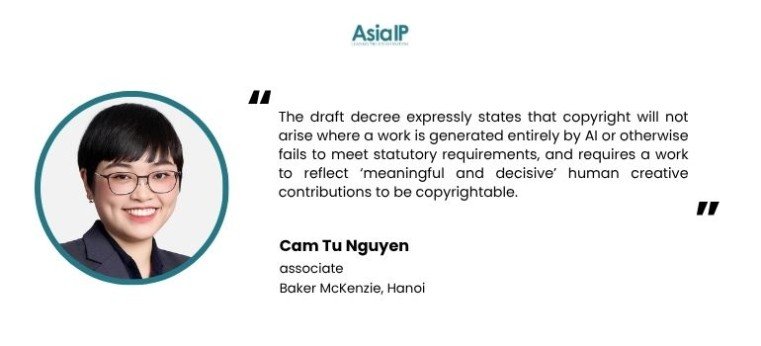
Vietnam’s IP Law has been amended and will take effect on April 1, 2026. The amendments seek to expressly resolve the issue of copyright ownership in the case of AI-assisted works. As of press time, the government’s decree on the issue is still being drafted. “In particular, the draft decree expressly states that copyright will not arise where a work is generated entirely by AI or otherwise fails to meet statutory requirements, and requires a work to reflect ‘meaningful and decisive’ human creative contributions to be copyrightable,” said Cam Tu Nguyen, an associate at Baker McKenzie in Hanoi.
Meaningful and decisive human creative contributions may come in the form of prompts. In the creative process, prompts are used to control the AI system. Likewise, evaluation, selection, edition, interference with or interpretation of results generated by the AI system are examples of meaningful and decisive human creative contributions. So with the acts of selection, arrangement and organization of content in order for the artistic creation to take shape. Making artistic, aesthetic or professional decisions with regard to the creative work and/or determination of the final outcome are other forms of meaningful and decisive human intervention.
The New Zealand Copyright Act 1994 likewise makes no express mention of AI. There seems to be no plans to update the act to expressly address copyright issues in the face of GenAI either.
“However, the act does provide that copyright may subsist in ‘computer-generated’ works, and that the author of such work will be ‘the person by whom the arrangements necessary for the creation of the work are undertaken,’” shared Blake Carey, a senior associate at AJ Park in Auckland.
“A computer-generated work is a work that is generated by a computer in circumstances such that there is no human author of the work. This broad definition would capture certain AI-generated works. What this all means is that, in New Zealand, copyright can subsist in works that are produced by generative AI, rather than by a human,” he explained.
When copyright ownership is questioned and how to prove it
The question of copyright ownership arises when an infringement lawsuit is filed and litigation takes place. The plaintiff must then prove he is the author or lawful owner of the AI-assisted content or artistic work.
Litigation can also happen when a declaratory judgment lawsuit is filed. “An accused infringer can also challenge the validity of the registration and whether the applicant was truthful regarding the extent to which AI was used to create it,” said Rourk.
Copyright ownership is also central in transactions involving intellectual property, such as licensing or assignments, when issuing takedown notices and during dispute procedures on online platforms.
In these situations, how does a creator prove ownership in the absence of adequate laws and regulations and copyright registries?
The keyword is “documentation.” Clear and comprehensive documentation. Copyright owners must document the whole process of creating an AI-assisted work early on to provide evidence of “originality” and “creativity.”