“It is essential to properly manage these risks through multi-dimensional collaborative governance to promote the healthy, sustainable and innovative development of the AI-powered film industry,” said Peng Zhang, senior counsel at Zhong Lun Law Firm in Beijing.
Are legal frameworks for IP in the region robust enough to address the use of AI in film, TV, video and digital media, considering the rising number of adopters? According to de Guzman, the Intellectual Property Code of the Philippines, like IP laws in many other jurisdictions, has significant limitations in fully addressing the complex IP challenges posed by AI in film production. One major hurdle is the IP Code’s very definition of “author” as a “natural person.” This means purely AI-generated works are not eligible for copyright protection.
“However, notwithstanding such challenges, it is worth noting that attempts have been made to pass AI-focused legislation. There are several AI-related bills previously introduced in the Philippine Congress that aim to establish regulatory frameworks for AI. While these bills are still in development and may have varying definitions and scopes, they demonstrate a legislative awareness of AI’s growing impact and the need for new laws,” noted de Guzman, who provides advisory services to production companies and individual creatives who are exploring or are already incorporating AI into their workflows.
“Singapore has not really addressed the liabilities of users of GenAI which has created work independently, from both primary and secondary infringement perspectives,” said Hwang. “For primary infringement, the infringer is the one who has committed the act of copying. For secondary infringement, there is a requirement that the infringer knows that the article dealt with commercially or distributed is an infringing article. The knowledge need not be actual. It can be constructive. The phrase used in our Copyright Act 2021 is ‘ought reasonably to know.’ To what degree should this be?” Hwang asked.
Hwang added that the Copyright Act 2021 has changed the phrase “fair dealing” to “fair use.” “Since ‘fair use’ is found in the U.S. Copyright Act, I would like to know how the Singapore court will construe this aspect of ‘permitted use,’” he said.
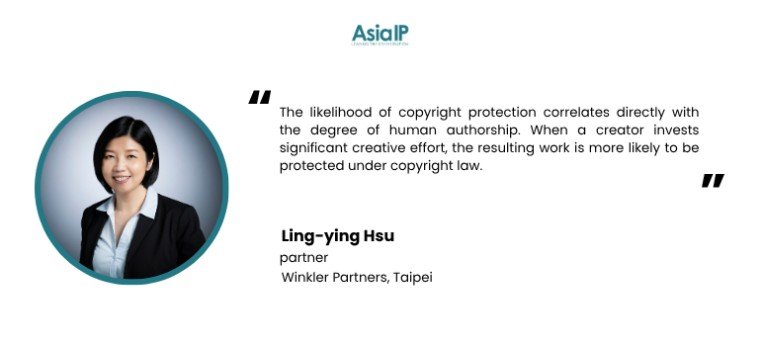
Under Taiwan’s IP law, AI-assisted works may receive copyright protection as long as significant and substantial human creative input is involved. This means that AI was merely used as a tool to create the work. In contrast, works that are independently generated by AI with no human intervention cannot have copyright protection.
However, the Taiwan Intellectual Property Office has yet to provide clear criteria on the level of human contribution required for a creative work to receive copyright protection. Not a single court ruling within the jurisdiction has specifically addressed this issue.
“As a result, it remains uncertain how film studios can confidently incorporate AI into their production process while ensuring their works are protected by copyright law,” said Hsu. Say, a film studio uses AI to create an initial draft of a scene for a movie. Later, this draft is modified, this time with human involvement. According to Hsu, two questions could arise: Would the resulting work be protected by copyright? How much human modification is needed before AI is considered merely a tool?
“I believe China’s legal system is capable of addressing these challenges, having established a considerable regulatory framework,” said Zhang. “At the foundational level, the Civil Code and Copyright Law codify the essential provisions for rights protection. The 2022 Provisions on the Administration of Algorithmic Synthesis in Internet Information Services and the 2023 Interim Measures for the Management of Generative Artificial Intelligence Services have introduced targeted requirements across various dimensions. These include mandating the use of legally sourced data and base models, prohibiting infringement of IP rights lawfully held by others, ensuring training data authenticity and reliability, among others,” he added.
How to avoid IP issues
What should production people in film, TV, video and digital media do to make sure their AI-assisted work outputs do not infringe copyright and are eligible for protection?
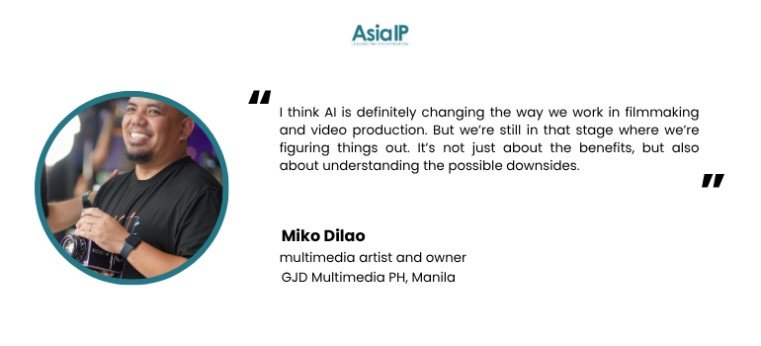
“We’re very mindful of that,” said Dilao. “For storyboarding, the AI-generated images we use are just for internal planning. They’re never published or used in the final output. It’s really just a tool to help visualize ideas early on, so we don’t run into IP issues there.”
When it comes to AI voiceovers, Dilao said, the company makes sure to use only legitimate, licensed platforms – usually subscription-based tools. “We know we’re staying on the right side of legal and ethical use. We’re careful with what we use and how we use it, especially since we also work with brands and clients who trust us to protect their reputation as well,” Dilao added.



-content_x-large.jpg)