

LESI 2026: Global SEP licensing faces pressure
28 April 2026
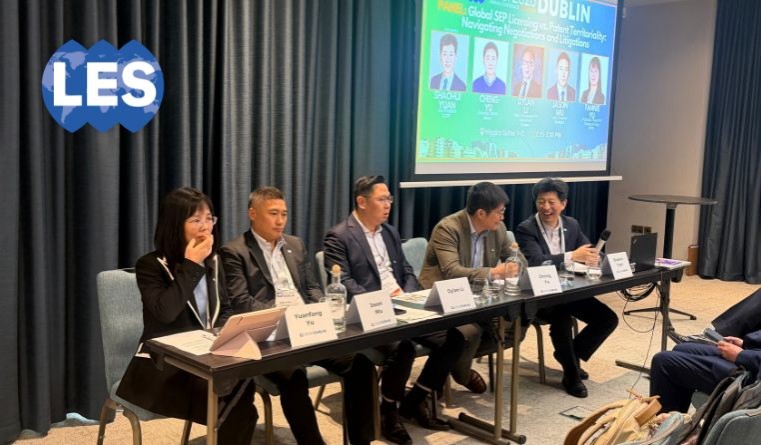
Tensions between globally licensed technologies and territorially enforced patents took centre stage at a Standard Essential Patent (SEP) licensing panel, held during the Licensing Executives Society International (LESI) annual meeting, as industry executives warned that fragmented litigation and information asymmetry are threatening innovation in standards-driven markets.
The panel brought together senior representatives from Oppo, Xiaomi, Huawei and InterDigital to debate how global SEP licensing can function efficiently when patent rights remain national by design.
At the heart of the discussion was a long-standing contradiction: modern technical standards such as 4G, 5G and Internet of Things (IoT) are implemented globally, while the patents that underpin them must still be enforced country by country.
“A structural mismatch”
Oppo’s IP strategy and policy director, Fannie Yu, described the current system as inherently inefficient, particularly for multinational companies operating across dozens of markets.
“Standardization is global, but enforcement is territorial. That mismatch has become the biggest pain point,” she said, warning that parallel litigation in multiple jurisdictions is increasingly used as a strategic weapon rather than a last resort.
She argued that these jurisdictional battles consume both business and judicial resources without resolving the underlying licensing disputes. “Instead of focusing on adopting technology and growing the ecosystem, we end up litigating the same issues again and again in different courts,” she said.
Litigation, mediation and global rates
InterDigital’s vice president and China general manager Jason Wu echoed those concerns, pointing to conflicts not only between patent territoriality and global SEPs, but also between courts in different countries that now claim authority to set global FRAND (fair, reasonable and non-discriminatory) rates.
Recent years have seen courts in the UK, China and the EU increasingly willing to determine worldwide SEP licences in a single forum – a trend that has reshaped global licensing strategy. UK courts affirmed this approach in Unwired Planet v. Huawei, while Chinese courts followed with landmark rulings in Oppo v. Nokia and InterDigital v. Oppo.
Wu suggested mediation and arbitration as alternatives to litigation, though he acknowledged skepticism within parts of the industry.
“There isn’t universal agreement, but mediation and arbitration can help parties bridge gaps that courts alone struggle to address,” he said.
Transparency and information asymmetry
For Xiaomi’s licensing director Cheng Yu and Huawei’s head of the European IPR department Dylan Li, who were also speaking on the panel, information asymmetry remains a central obstacle.
Patent holders typically possess detailed knowledge of their portfolios, essentiality claims and global valuation models, while implementers often lack equivalent access – a problem compounded by confidential licensing agreements and sealed court decisions.
“Information symmetry is still missing,” Yu said. “Without transparency, predictability in licensing is extremely difficult.”
The issue has drawn increasing regulatory attention. The European Commission has proposed mandatory SEP disclosure mechanisms to reduce asymmetry, while industry groups have pushed for publicly accessible databases and clearer comparables in global rate-setting.
Pools, courts and geopolitics
Li pointed to patent pools as a pragmatic solution, especially for small- and medium-sized enterprises that lack the resources to negotiate dozens of bilateral licences.
“Pools offer credibility, transparency and industry recognition, particularly for smaller players,” Li said.
At the same time, the panel acknowledged that courts will continue to play a decisive role – not least because governments are now closely watching how SEP disputes affect trade and competition.
In early 2025, the European Union launched consultations at the World Trade Organization (WTO) against China, arguing that Chinese courts’ practice of imposing binding global SEP rates interferes with foreign jurisdictions and violates transparency obligations under international trade law.
These developments underscore how SEP licensing has become entangled with geopolitics, particularly as Chinese companies transition from net licensees to major licensors in 5G and emerging 6G technologies.
Toward a more predictable system
Despite differing perspectives, panelists agreed on one point: the status quo is unsustainable.
Yu of Oppo advocated for court-set global rates in appropriate venues, backed by transparent methodologies and comparable licences.
“We need venues that are closely connected to the dispute and capable of setting global rates in a credible way,” she said, adding that mediation can still play a constructive role alongside litigation.
As standards underpinning AI, connected vehicles and industrial IoT proliferate, the stakes continue to rise. Without greater coordination, transparency and trust, panelists warned, SEP disputes risk becoming a brake on the very innovation they are meant to reward.
“A balanced ecosystem is in everyone’s interest – patent holders and implementers alike,” Yu concluded.
- Darren Barton in Dublin