
Yes, you may copyright your joke! (And we’re not joking)
15 January 2026
As literary and artistic works, jokes are indeed copyrightable, says Espie Angelica A. de Leon, but proving originality and ownership remains a challenge across different contexts.
“I’m so happy a carwash service just opened near our house. It’s within walking distance, so I don’t even need to bring a car!”
Funny? In the Philippines, it’s known as the carwash joke. Filipino comedian Alex Calleja delivered it in Tagalog, the local language, in his stand-up comedy special titled Tamang Panahon (Right Time in English), which was the most-streamed show on Netflix Philippines in February 2025.
Well, Filipino gag writer Chito Francisco certainly found it funny. When the show came out on Netflix, Francisco accused Calleja of stealing the joke from him. He even posted photos of himself and the stand-up comedian on Facebook and shared a version of the joke, which he said he wrote in 2019.
Calleja denied the allegation, revealing that he created the carwash joke in 2011, as evidenced by his Facebook post from September 9, 2013, in which he shared the joke. He also said he would file a cyberlibel case against Francisco. Eventually, the latter issued a public apology to the stand-up comedian, saying he deeply regretted his action. Calleja accepted the apology.
As it turned out, Alex Calleja had the last laugh.
Whether Calleja pursued the cyberlibel complaint or not is unknown. But what about his copyright ownership over the carwash joke? In the first place, can a gag obtain copyright protection?
The answer is yes, a joke – or a gag or wisecrack – can obtain copyright protection. Jokes are literary and artistic works, hence they are copyrightable. Copyright automatically subsists once the artistic work is completed and expressed.
“The joke would have to be expressed in a tangible form, such as in writing, in a performance, in a recorded video or similar media,” said Micah Cheyenne M. Ecarma-Vargas, an associate at ACCRALAW in Manila.
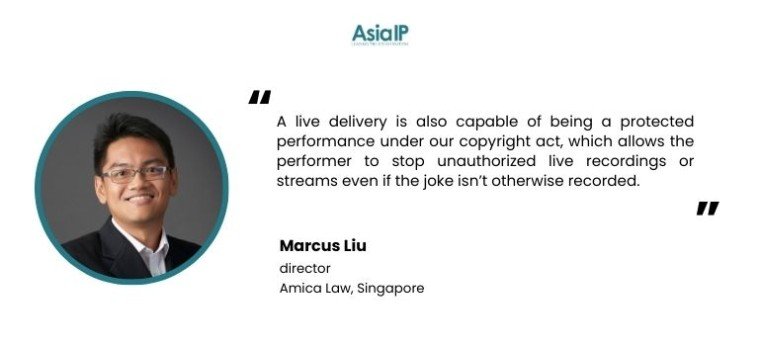
“A live delivery is also capable of being a protected performance under our copyright act, which allows the performer to stop unauthorized live recordings or streams even if the joke isn’t otherwise recorded,” said Marcus Liu, a director at Amica Law in Singapore. He added that the protected performances regime is a rather useful development. “[It is] helpful for touring comics like the Just For Laughs comedy festival,” which debuted in Singapore in November and December 2025, he pointed out.
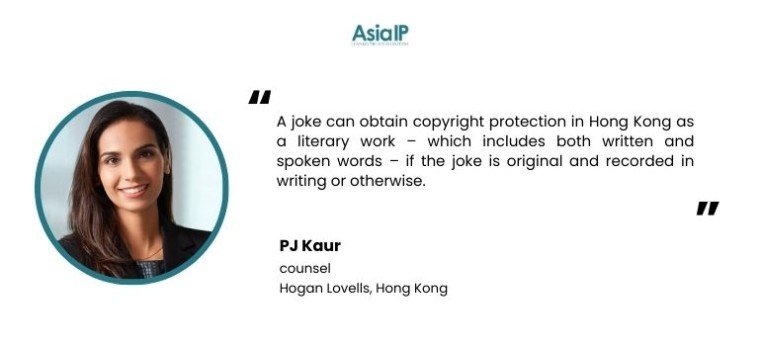
“Yes, a joke can obtain copyright protection in Hong Kong as a literary work – which includes both written and spoken words – if the joke is original and recorded in writing or otherwise,” said PJ Kaur, counsel at Hogan Lovells in Hong Kong.
However, Kaur added that the Hong Kong Copyright Ordinance does not define the word “original.” Based on case law, the key question is whether the author used his or her independent skill, labour or judgment in making the artistic work. “This is a relatively easy threshold to satisfy and there is no need for a joke to reflect any originality of thought, novelty or creativity,” Kaur said.
The Hong Kong Copyright Ordinance also provides that in instances when a joke is first spoken out loud, say at a stand-up comedy show, it is important to ensure that it is recorded – whether in writing or otherwise – for it to be copyright protected.
In India, a joke in the form of a story-based routine, comic strip or longer sketch, as opposed to a short phrase, is qualified for copyright protection. “Another person narrating the same conceptual joke in their own words may still be able to do so without violating someone’s rights,” said Safir Anand, a senior partner and head of trademarks at Anand and Anand in Noida.
Anand shared that an incident in India similar to the joke-stealing allegation in the Philippines had one producer accusing a popular stand-up artist of reusing parts of an older show. The parts he was reusing included some gags. According to Anand, it isn’t known how the issue was resolved.
Copyright registration for jokes and proving ownership
In the Philippines, copyright holders may register and deposit their works with the Intellectual Property Office of the Philippines or the National Library, which will issue them a Notice of Copyright bearing the name of the copyright owner and the year of its first publication.
They may also execute an affidavit stating that at the time specified therein, copyright subsisted in the work or other subject matter; the person named therein is the owner of the copyright; and the copy of the work or other subject matter annexed thereto is a true copy thereof.
To further prove copyright authorship, especially if the work is not registered and in the absence of an affidavit, Vargas said it is advisable to keep dated evidence. “Such evidence may include a video recording of the comedy routine where the joke was delivered, a written and dated social media post or similar proof of authorship,” she said.
“This ability to document in a fixed form in writing on paper, or email or any digital method, including recording in an audio or video format with a date and time stamps, shows evidentiary value. Witnesses who witnessed the creation of the copyright could also be arguably used to establish one’s ownership,” Anand said. “However, that depends upon the facts and circumstances of the matter.”
Like the Philippines, India also has a copyright registry under its Copyright Office. Singapore and Hong Kong have no such registries.
“Keeping evidence leading up to the creation and publication of the work is thus paramount,” said Liu. Such evidence may include dated drafts or scripts, footage or audio with metadata. “As a practical step, authors can execute a statutory declaration recording creation facts which can later be referred to in proceedings if necessary,” Liu added.
In Hong Kong, proof of copyright subsistence and ownership in legal proceedings is primarily based on an affidavit evidence stating the following: date and place that the work was made or first published; details of the author; name of the copyright owner; that copyright subsists in the work; and that a copy of the work exhibited to the affidavit is a true copy of the work.
Of course, other forms of evidence, such as a timestamped publication of the joke and drafts of the work, will always be useful, as in other jurisdictions.
“From a practical perspective, it may be advisable for the copyright owner of a joke to include a copyright notice, comprising the copyright (©) symbol along with the owner’s name and year of publication at the bottom of any published content,” said Kaur.
Jokes and copyright: challenges
As previously mentioned, jokes must be fixed in a tangible medium, such as writing or recording, in order to be protected by copyright. Otherwise, problems may arise.
In Singapore, which has no regime for copyright registration, many authors do not undertake reliable record keeping. This makes it difficult to trace the chain of evidence of creation, and therefore determine the ownership of copyright.
In the age of social media, this problem can spiral. “With the advent of social media, if a joke is not documented prior to performance, the chances of the creator losing their rights due to the immediate virality of the joke could pose a huge challenge,” noted Anand.
However, there are remedies available, according to Liu. “There are some presumptions set out in the Copyright Act from Section 164 to Section 171 for different types of works. One of the more useful ones is the presumption of authorship, where a name appears on a work which provides a starting point of copyright ownership,” explained Liu. However, he pointed out that these presumptions are also rebuttable.
“In principle, obtaining and proving copyright protection over a joke should not present major challenges if done in a straightforward manner. However, when ownership is contested, the primary challenge is that the person claiming copyright must prove three aspects: authorship, originality and creativity,” Vargas pointed out.
To prove authorship, the claimant must show he is the true and sole creator of the joke. This means the claimant neither collaborated with another person nor received assistance from AI during the process of creating the gag. The prevalence of AI has made this practice very common nowadays.
“Proving originality also presents difficulties, as the claimant must show that the joke was not recycled or rehashed from existing material, and that it is genuinely original,” said Vargas.
Meanwhile, proving creativity is essential, she said. This component is embodied under Section 175 of the Philippine IP Code. The section states that mere ideas, procedures, methods, concepts, discoveries or data are excluded from copyright protection, as are mere facts, news of the day and other press-related information.
“Additionally, while Section 172.2 of the IP Code states that ‘works are protected by the sole fact of their creation, irrespective of their mode or form of expression,’ the Supreme Court clarified in the recent case of Republic v. Tupaz that ‘copyright solely belongs to the person who fixes an idea into a tangible medium of expression. The law on copyright only protects the expression of an idea, not the idea itself. Thus, one who merely contributes concepts or ideas is not deemed an author,’” Vargas added.
Also facing hurdles on the wayside of claims for copyright protection are wisecracks that are generic or extremely brief, such as jokes composed of single words, titles or slogan-like phrases.
“Traditionally, the practice of protecting a short phrase, punch or a one-liner, at times, can be questioned as it may appear too minimal to qualify for copyright protection and to be assessed on the standard of originality,” Anand said.
“It is a matter of judgment whether there is sufficient intellectual input and content to qualify very short phrases as original literary works,” Liu added. “It also becomes more difficult to separate the permissible protection of the expression of the work as opposed to the non-permissible protection of the ideas. It would generally be difficult to protect a bare concept or very short commonplace phrase.”
According to Anand, the principle that usually applies to jokes consisting of short phrases, punchlines or one-liners is similar to that which may be applied to the protection of slogans and taglines, which are otherwise protected as trademarks.
“However, in my view, especially in today’s time where social media memes trend and acquire distinctiveness overnight, there should certainly be protection of jokes, including for short-form ones under copyright,” Anand stated.
However, the manner in which the joke was uttered or delivered may be the big difference. Anand explained: “Short jokes sometimes may lack originality, but their manner of delivery may make them popular. In such cases, the nature of protection may not be on the short phrase or joke but the manner of delivery which may be subsumed within personality rights of the artist.”
He cited as an example the phrase “Okay, let’s go.” It is definitely a short and very simple phrase. Yet, it trended on social media in India because of the manner in which it is spoken. “Technically, the words may be common and may not meet the threshold of originality. However, it is certainly possible to protect it as copyright in the manner that it is spoken, presumably in an audio or video format,” Anand explained.
Another example is “So beautiful, so elegant. Just looking like a wow!” The words were uttered by a small-time garment manufacturer in India in a video showing her with the garments. She said those words to express her appreciation of the garments’ designs and quality. The video trended and made the statement very famous in India. “Now, in such a situation, to some extent, the threshold of originality is met since this is not how the phrase would ideally be used. As such, it could also be protected as copyright in the manner that she used the phrase in an audio or video format,” Anand remarked. “With the development of jurisprudence on personality rights in India, there is certainly a path that can be followed for the protection of jokes under copyright.”
Modified gags may also face challenges. These are jokes consisting of names of people or places which have been changed from another person’s wisecrack. “The modification does not meet the test for originality,” said Kaur.
So if you’re a gag writer or a comedian who comes up with your own toolbox of wisecracks, remember that jokes are creative or artistic works too. Hence, they are eligible for copyright protection as long as they meet the criteria under your country’s copyright law. Keep this in mind, and you will be safe from infringers and copycats when a copyright dispute arises. Believe me, you’ll have the last laugh!