

Vietnam IP Guide 2025
05 November 2025

Trademarks
A trademark is defined as a sign used to distinguish the goods or services of one organization or individual from those of others. In Vietnam, for a sign to be eligible for trademark protection, it must be visible. This includes not only traditional visual marks but also sound marks, provided they can be represented graphically.
However, not all signs qualify for protection, including signs that are identical or confusingly similar to the following:
- National symbols, such as flags and emblems;
- The emblems, flags, names (full or abbreviated) and insignia or armorial bearings of Vietnamese state agencies, political organizations, and international bodies, unless express permission is granted;
- The use of real names, pseudonyms, pen names, or images of national leaders, heroes or other famous individuals (whether Vietnamese or foreign);
- Official seals, such as certification, control, or warranty seals of international organizations that prohibit such use, unless the organization itself registers the seal as a certification mark; or
- Any sign that could mislead consumers about the origin, quality, value or characteristics of the goods or services is not eligible for protection.
To file a trademark application in Vietnam, the following documents and information are required:
- The applicant’s full name and address;
- A high-resolution JPG file of the trademark sample;
- A power of attorney signed in original wet-ink (electronic signatures are not accepted); and
- A certified priority document, if the applicant is claiming priority rights.
Trademark applications may be refused on absolute grounds, such as if the mark is overly simple, generic, descriptive, deceptive or misleading, with certain exceptions. Trademarks may also be refused on relative grounds under Vietnam’s first-to-file principle. A trademark may be rejected if it is identical or confusingly similar to:
- A previously registered trademark or pending application for similar goods or services;
- A widely used or well-known mark that predates the application;
- A trade name currently in use, where the new mark could cause confusion about the origin of the goods or services;
- A protected geographical indication (GI), if the mark could mislead consumers about the origin;
- A protected or pending industrial design with an earlier filing or priority date; or
- Widely known copyrighted characters or figures, unless permission is obtained from the copyright holder.
Registration
The registration process typically unfolds in several stages:
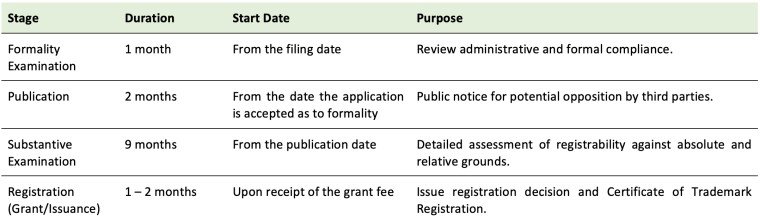
In practice, the whole process may take 16-24 months in a smooth case.
Once granted, a trademark is protected for 10 years from the filing date. It can be renewed indefinitely in 10-year increments, provided the renewal fee is paid. Renewal requests must be filed within six months before the current term expires. A grace period of six months is allowed for late renewals, subject to an additional fee.
Vietnam does not require a declaration or affidavit of use. However, if a registered trademark is not used for five consecutive years following its registration, it may be subject to cancellation due to non-use. Therefore, it is advisable to ensure that the mark is actively used in commerce to maintain its protection.
Patents
A patent in Vietnam is defined as a technical solution, either in the form of a product or a process, that applies natural laws to resolve a specific problem. This protection is designed to encourage innovation by granting exclusive rights to inventors for their creations.
Not all subject matter qualifies for patent protection. The following are excluded from such protection:
- Scientific discoveries, theories and mathematical methods;
- Schemes, plans, rules and methods for mental activities, training animals, playing games or conducting business;
- Computer programs;
- Presentations of information;
- Solutions that are purely aesthetic in nature;
- Plant varieties, animal breeds and essentially biological processes for producing plants and animals, except for microbiological processes; and
- Methods for preventing, diagnosing or treating diseases in humans and animals.
Vietnam recognizes two forms of patent protection: invention patents and utility solution patents. An invention patent requires novelty, an inventive step and industrial applicability. A utility solution patent, on the other hand, requires novelty and industrial applicability but must not be considered common knowledge. For both types, novelty means the invention must not have been disclosed anywhere before the filing or priority date, subject to certain exceptions. The inventive step criterion ensures that the solution is not obvious to a person skilled in the relevant field, while industrial applicability requires that the invention can be practically applied and reproduced with stable results. For utility solutions, the requirement of not being common knowledge ensures that the solution goes beyond routine technical understanding.
An invention will not be considered to have lost its novelty if it was publicly disclosed under specific circumstances, provided the patent application is filed within a 12-month period starting from the disclosure date. The qualifying disclosures under this grace period are those made by:
- The inventor/applicant: Disclosures made by the person entitled to register the invention (the inventor or their legal successor), regardless of the reason for the disclosure (e.g., testing, public presentation, etc.), or,
- A third party (deriving information): Disclosures made by a person who obtained the information about the invention directly or indirectly from the person entitled to register it (e.g., a breach of confidentiality).
To file a patent application, applicants must submit a Vietnamese patent specification, which includes a detailed description of the invention, claims defining the scope of protection, any relevant drawings, and an abstract of no more than 150 words. A power of attorney signed in original wet ink is required, as electronic signatures are not accepted. If claiming priority rights, a certified priority document must also be provided.
The registration process involves several stages.
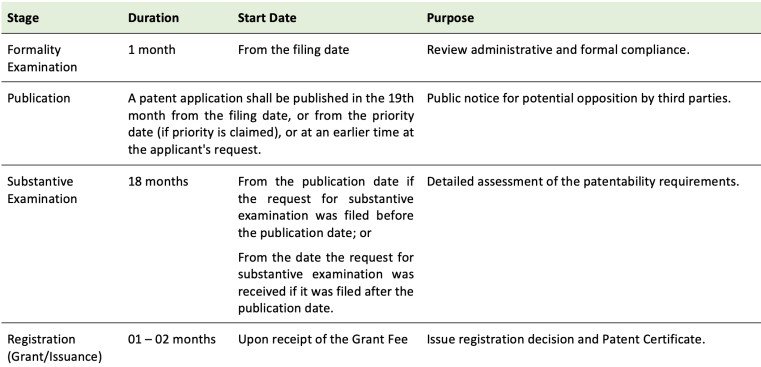
In practice, the whole process may take 24-36 months in a smooth case. Vietnam also participates in Patent Prosecution Highway (PPH) programmes, which allow examination results from foreign patent offices such as the USPTO, EPO, JPO, and KIPO to expedite the process.
The term of protection for an invention patent is 20 years from the filing date, while a utility solution patent is valid for 10 years. Both require timely payment of annual maintenance fees, and although no extensions beyond these terms are permitted, a six-month grace period for late payment is allowed upon payment of an additional fee.
Industrial designs
An industrial design refers to the specific appearance of a product, expressed through three-dimensional configurations, lines, colours or a combination of these elements, and visible during the product’s use or operation. This protection applies to both individual products and complex products, provided their appearance meets the legal requirements.
However, certain subject matters cannot be protected as industrial designs. These include appearances dictated solely by the technical features of a product, the external look of civil or industrial construction works and shapes that remain invisible during the product’s use. Additionally, any design that conflicts with social ethics, public order or national defence and security is excluded from protection.
To qualify for registration, an industrial design must satisfy three key criteria. First, it must be novel, meaning it differs significantly from any design that has been publicly disclosed anywhere in the world before the filing or priority date. Second, it must demonstrate creativity, in that it cannot be easily conceived by a person of average skill in the relevant field based on existing designs. Finally, it must be susceptible to industrial application, meaning it must be suitable for mass production through industrial or handicraft methods as a model for products.
Applicants must submit a set of drawings or photographs accompanied by a description of the design. A power of attorney signed in original wet ink is required, as electronic signatures are not accepted. If claiming priority rights, a certified priority document must also be provided.
The registration process involves several stages.
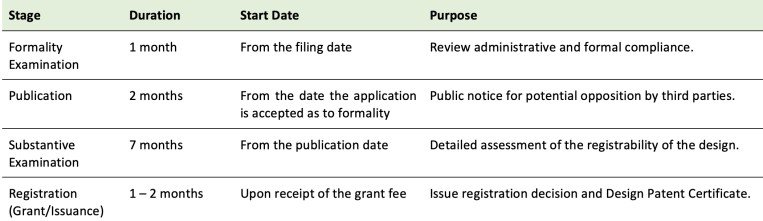
In practice, the whole process may take 16 – 20 months in a smooth case. The term of protection for an industrial design begins on the date of issuance and lasts for five years from the filing date. This term can be renewed twice, each for an additional five years, allowing a maximum protection period of 15 years. If the design includes multiple variants, renewal may apply to all or some of them, provided the primary variant is included. Renewal requests must be filed within six months before the certificate’s expiration, and a six-month grace period is available for late renewals upon payment of an additional fee.
Copyrights
Copyright and related rights in Vietnam are primarily governed by the Law on Intellectual Property of 2005, as amended in 2009, 2019, and 2022, along with supporting decrees and circulars. Vietnam is also a member of key international treaties, including the Berne Convention, the WIPO Copyright Treaty and the TRIPS Agreement, ensuring that foreign works enjoy the same level of protection as domestic creations.
In Vietnam, copyright protection arises automatically upon the creation of a work, provided it meets two essential conditions: originality of the creation and fixation in a tangible form. This means that registration is not required for protection to exist. The law specifies a broad range of protectable works, including literary, artistic, and scientific creations expressed in physical form, while also listing categories of works that are excluded from protection. Authorship generally belongs to the individual who creates the work, although ownership may rest with organizations or employers under contractual or employment arrangements.
The law distinguishes between moral rights, which are largely perpetual – such as the right to authorship, attribution and integrity – and economic rights, which are time-limited and cover activities like reproduction, distribution and licensing. Foreign works benefit from the same standards through Vietnam’s membership in the Berne Convention and the TRIPS Agreement.
Although registration is not mandatory, copyright owners may choose to register their works with the Copyright Office of Vietnam under the Ministry of Culture, Sports and Tourism. A copyright registration certificate serves as prima facie evidence of ownership in case of disputes. The registration process involves submitting the required documents, paying official fees based on the type of work and undergoing a review by the copyright office. If deficiencies are found, applicants have one month to correct them. The entire process typically takes between one-and-a-half and two months.
The term of protection varies depending on the type of right and work. Moral rights, which safeguard the author’s personal and reputational connection to the work, are generally protected indefinitely, except for the right of publication. Economic rights and the right of publication are time-limited: cinematographic, photographic, applied art, and anonymous works are protected for 75 years from first publication, or 100 years from fixation if unpublished within 25 years. Other works, such as literary or musical creations, are protected for the author’s lifetime plus 50 years after death or, for joint works, 50 years after the last surviving co-author’s death.
Related rights, covering performers, producers, and broadcasters, are protected for 50 years from performance, publication or broadcast.
Vietnamese law also addresses online copyright enforcement through safe harbour provisions and notice-and-takedown procedures for internet service providers (ISPs). ISPs offering transmission, caching or hosting services are exempt from liability if they comply with legal requirements. They must implement mechanisms for copyright owners to request takedowns and act promptly: infringing content must be removed within 24 hours upon request from competent authorities and temporarily taken down within 72 hours upon request from copyright owners, with notifications sent to the content owner. If the content owner does not object, the removal becomes permanent; if they do, the content is restored within 72 hours, and disputes must be resolved through courts or other legal means. ISPs may also remove livestream content immediately if a takedown request is submitted at least 24 hours before the scheduled stream.
IP enforcement
Vietnam’s intellectual property enforcement system is governed by a comprehensive legal framework, including the Law on Intellectual Property (2005, amended in 2009, 2019, and 2022), the Law on Handling Administrative Violations (2012, amended in 2020 and 2025), the Criminal Code (2015, amended in 2017), the Civil Code (2015), and procedural laws for civil and criminal matters, as well as the Law on Customs (2014, amended in 2025). These statutes are supported by guiding decrees and circulars, creating a multi-layered enforcement regime.
Enforcement routes
IP rights in Vietnam can be enforced through several routes, each offering different levels of deterrence. These include self-protection measures, civil litigation, administrative sanctions, criminal prosecution and border control measures. For foreign IP owners, enforcement requires appointing an authorized IP agent in Vietnam through a notarized and legalized power of attorney.
Administrative enforcement applies to all IP rights and typically involves warnings and monetary fines. Penalties can reach up to D250 million (US$9,500) for individuals and D500 million (US$19,000) for organizations, depending on the severity of the infringement. Administrative proceedings usually take three to six months.
Civil litigation offers remedies such as compensation for damages, attorney fees, injunctions, and public apologies. Compensation is based on actual damages supported by evidence, but statutory damages are available when proof is limited, capped at D500 million (US$19,000). Reputation damages may also apply for certain IP rights, up to D50 million (US$1,900). Civil cases typically take 12–24 months and may extend further if appealed.
Enforcement agencies
Vietnam’s enforcement system involves multiple agencies. The Market Surveillance Force actively monitors the domestic market and operates at both provincial and ministerial levels. The Economic Police handle administrative and criminal actions, with structures at ministerial, provincial and ward levels. Customs authorities oversee import and export controls through 20 regional offices nationwide. Additionally, IP Specialized Courts, established on July 1, 2025, in Hanoi and Ho Chi Minh City, adjudicate civil and administrative IP disputes, though they currently lack jurisdiction over criminal cases.
Border protection
Customs recordal is a powerful tool for IP owners seeking to prevent counterfeit goods from entering Vietnam. IP owners can file a recordal request with the Customs Department, which typically issues an acceptance notice within one to one-and-a-half months. Recordals are valid for two years or until the trademark registration expires, whichever comes first, and can be renewed for another two years. Under this system, IP owners may register authorized manufacturers and importers (a whitelist) and flag known infringers for monitoring. Customs can seize counterfeit goods ex officio or at the IP owner’s request. When requesting a seizure, IP owners must provide a monetary bond equal to 20 percent of the shipment’s value or at least D20 million if the value is unclear. The bond is refunded if infringement is confirmed; otherwise, the IP owner is liable for damages caused by the request.
IP Crime
Criminal enforcement is reserved for serious infringements, such as copyright violations and counterfeiting of trademarks or geographical indications. Individual offenders may face fines of up to D1 billion (US$38,000), non-custodial sentences of up to three years or imprisonment ranging from six months to three years. Additional penalties include fines up to D200 million (US$7,600) or restrictions on business activities. Organizations can face fines up to D5 billion (US$190,000) or business suspension for six months to two years. Criminal proceedings generally last 12–18 months.
Expert opinions
While expert opinions are not mandatory in enforcement proceedings, they can serve as critical evidence. The Copyright Examination Centre (CEV) under the Copyright Office provides expertise for copyright and related rights, while the National Intellectual Property Institute (VIPRI) under the Ministry of Science and Technology handles industrial property rights.
About the author