


Turning your IP into collateral
20 March 2026

Can intellectual property replace physical assets as loan security? As ideas grow more valuable, business are trying to use IP for financing – but lenders remain cautious. Excel V. Dyquiangco unpacks the risks and practical challenges involved.
For many businesses – especially startups, technology firms and brand-driven enterprises – their most valuable assets aren’t factories or equipment, but ideas. Its intellectual property, for example, often represents years of innovation, market positioning, and consumer trust. Increasingly, financial institutions are recognizing this value and allowing IP assets to be used as collateral for loans.
Leveraging intellectual property to secure financing can unlock critical growth capital without diluting ownership. According to Tris Xavier, an associate director and head of integrated property practice group at Yuen Law in Singapore, IP assets are, like any other assets, carriers of value, where their shares can be used as collateral.
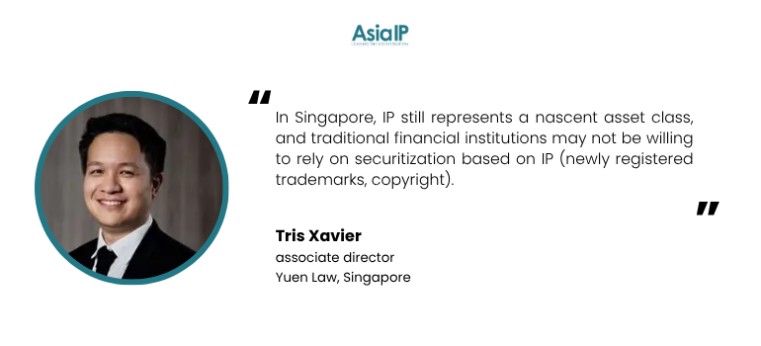
“Our experience is that IP asset owners rely on their assets as security for loans extended by the lender (basically creating a charge or pledge over the IP assets), most commonly as a floating charge,” he said. “In Singapore, IP still represents a nascent asset class, and traditional financial institutions may not be willing to rely on securitization based on IP (newly registered trademarks, copyright).”
Xavier said that the Intellectual Property Office of Singapore (IPOS) launched an IP Financing Scheme in April 2014 with several financial institutions to increase access to IP-backed financing for asset-light but IP-rich companies, where the government co-shared the loan loss risk to encourage them to accept collateralization based on IP assets. However, the scheme was retired in 2018 due to high upfront valuation costs and a lack of familiarity with IP as collateral, and a lack of secondary markets for IP assets.
“That said, Singapore recently launched Singapore IP Strategy 2030, which includes plans for further intangible assets or property valuation and disclosure,” he added.
He said that while IP valuation remains a nascent practice in Singapore, most valuation firms operating in the area would likely look at the income of the business which can be attributed to the IP (and where the IP is core to the firm’s creation, the revenue stream of the company). “They would also likely look at similar businesses with similar IP. There is a growing pool of professional service providers to facilitate transactions as well,” he said.
Using IP for loans
So, if businesses want to use IP to secure loans, where and how should they start? Businesses should first catalog and document their IP to ensure that any presentation or handling of IP represents a complete and comprehensive picture of the true standing of their IP, said Xavier.
“This also includes documenting its existence, identifying its creation (particularly for unregistrable IP like copyright or trade secrets), and where necessary, confirming if it is such an asset,” he said. “Thereafter, businesses should ensure that their contracts have or do not create situations where the IP has already been subject to a security arrangement or belongs to someone else (particularly if the business is involved in joint venture arrangements).”
For Lin Li Lee, a partner at Tay & Partners in Kuala Lumpur, it must begin with careful legal, commercial, and organizational preparation, as IP-backed financing requires significantly more groundwork than conventional secured lending.
“The first essential step is to identify all relevant IP assets, paying particular attention to whether the IP is registered, owned by the business, and legally enforceable,” she said. “This is critical because lenders will filter out unregistered or poorly documented IP and only consider IP that the borrower can clearly prove ownership of.”
She continued: “Once the IP assets are identified, the legal ownership and control of those assets are to be ascertained. Any IP that is registered in the name of founders or related entities must be formally assigned to the borrowing company. Likewise, IP that is licensed from third parties is generally unsuitable for use as collateral, as the borrower cannot grant enforceable security rights over assets it does not own. Lenders require that the borrower have full legal authority to grant security over the IP.”
-content_x-large.jpg)
According to Lee, the business should then assess whether its IP can generate revenue, either directly through licensing or indirectly through the sale of products or services protected by the IP. “Lenders realistically only consider IP that supports identifiable and sustainable income generating sources, since loan repayment ultimately depends on the commercial exploitation of the IP rather than its mere existence,” she noted.
“Finally, the business should prepare to integrate its IP assets into its business and financing narrative, clearly explaining how the IP underpins its competitive position, revenue model and growth strategy. In Malaysia, IP is rarely accepted as standalone collateral, so lenders typically evaluate IP in conjunction with cash-flow forecasts, business plans and, where applicable, additional security or guarantees,” she added.
“Taking these steps,” she said, “the business can present its IP not merely as a legal right, but as a credible, enforceable and income-generating asset capable of supporting debt financing within Malaysia’s current legal and market framework.”
Common mistakes to avoid
Like any other assets of value, businesses may make critical errors when trying to use their IP to secure financing. “IP owners tend to be overly positive about the value of their IP, and often become sorely disappointed (and sometimes overstretched) due to the difference in value,” said Xavier.
Another common problem with IP, he pointed out, is that businesses are not presently mandated to disclose their IP, and as such, there may be a lack of informational flow, allowing lenders to make a clear decision. “Businesses are encouraged to disclose more, including the status of their IP and their audit processes to give lenders confidence, and valuations where available,” he added.
Lee added that when using intellectual property to secure financing, businesses frequently encounter difficulties not because IP lacks value, but because of avoidable legal, organizational and commercial missteps that undermine lender confidence.
“A common mistake is failing to establish clear ownership of IP assets. Businesses often discover very late that key IP is registered in the names of founders or holding entities rather than the borrowing company itself. This prevents the borrowing company from granting enforceable security over the IP which can be avoided by conducting early IP audits and ensuring that all relevant IP is properly assigned to the borrowing entity before approaching lenders,” she said.
She said that another frequent error is relying on unregistered or weakly protected IP. “Unregistered rights are difficult to verify and enforce, making lenders reluctant to accept them as security. IP that has lapsed due to missed renewals would be too risky and lenders frequently reject such security. Businesses can mitigate this risk by prioritizing registration, maintaining renewal schedules and ensuring that IP protection aligns with key commercial markets,” she said.
“Poor documentation also often undermines many IP-backed financing attempts,” she added. “The power of complete records cannot be underestimated in financing transactions. Unclear licensing arrangements, inadequate employee IP assignment agreements, missing contracts all increase due-diligence costs and delay transactions, often leading lenders to withdraw. Maintaining organized, up-to-date IP documentation significantly improves lender confidence and reduces transaction friction.”
“In the upshot, to succeed in IP-backed financing, legal ownership, protection, valuation and commercial use of the IP must be aligned with lender risk requirements from early days,” she said.