


The legal landscape of web scraping
20 February 2026

The rise of web scraping has transformed how businesses and researchers collect and analyze online data. However, this powerful tool also raises complex legal and ethical questions, particularly regarding intellectual property rights. When does scraping cross the line from fair use to infringement? Excel V. Dyquiangco reports.
The rise of web scraping has transformed how businesses and researchers collect and analyze online data, fuelling innovations in ecommerce, finance and artificial intelligence. However, this powerful tool also raises complex legal and ethical questions, particularly regarding intellectual property rights. When does scraping cross the line from fair use to infringement? And how do existing copyright, database rights and terms of service agreements shape the legality of these practices?
While some argue that publicly accessible data should be free for analysis, others stress the need to protect proprietary information from unauthorized use. Landmark cases, such as those involving major social media platforms and data analytics firms, highlight the ongoing tension between innovation and IP protection.
In Australia, there are no laws or jurisprudence relating specifically to web scraping. However, a court will determine whether data obtained through web scraping qualifies as a trade secret by first determining whether the data has the necessary quality of confidence. That is, the court will consider whether the information is confidential.
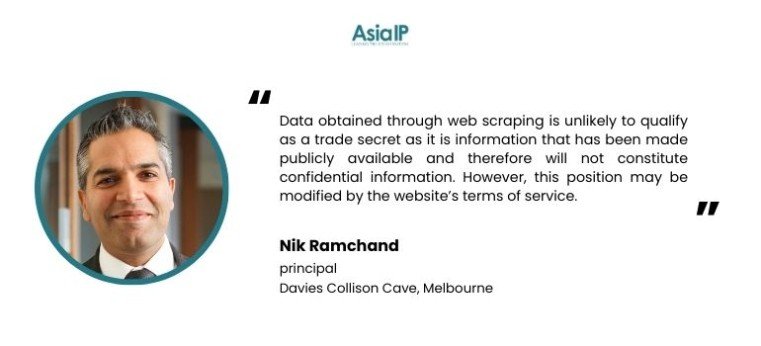
“In this regard, data obtained through web scraping is unlikely to qualify as a trade secret as it is information that has been made publicly available and therefore will not constitute confidential information,” said Nik Ramchand, a principal and head of the electrical and IT practice group at Davies Collison Cave in Melbourne. “However, this position may be modified by the website’s terms of service, which may be effective in giving the data the necessary quality of confidence. The implication of this is that use of that data by the web scraper outside of any use allowed by the terms of service will likely be a breach of those terms as well as a breach of confidence.”
While information that is publicly displayed on a website is unlikely to be a trade secret as it will not be confidential, information that is intended to protect as a trade secret should not be made publicly available for scraping on a website. Where the information is not publicly available or is considered confidential with reference to the website’s terms of service, then any data scraping will likely constitute a breach of confidence.
“Although I have not encountered any notable cases where web scraping was challenged as trade secret misappropriation, this is unsurprising as web scraping would more likely become the subject of a contractual dispute relating to breach of the website’s terms of service,” Ramchand said.
In Qatar, the legal landscape surrounding web scraping is still somewhat unclear. There are no specific laws or court cases that directly address the issue, which means there is no established precedent to guide how such activities might be viewed legally. This lack of clarity can make it difficult to determine whether certain types of scraped data, especially if publicly accessible, could be considered a trade secret.
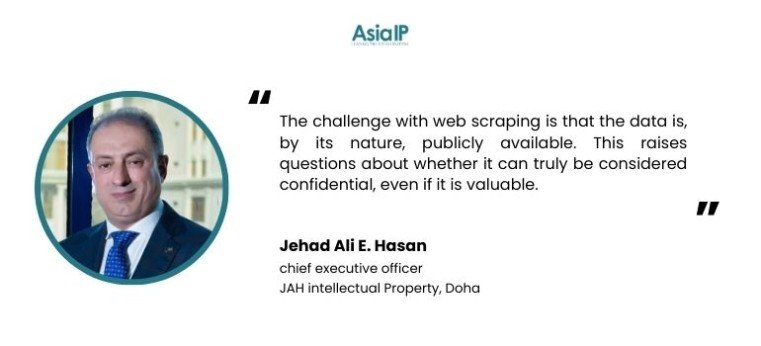
According to Jehad Ali E. Hasan, chief executive officer of JAH intellectual Property in Doha, generally, for information to be classified as a trade secret, it needs to be confidential, provide a competitive edge, and the owner must take reasonable steps to keep it secret. “The challenge with web scraping is that the data is, by its nature, publicly available,” he said. “This raises questions about whether it can truly be considered confidential, even if it is valuable.”
However, web scraping activities in Qatar are subject to several intersecting legal frameworks:
-
Copyright Law (Law No. 7 of 2002): This law protects literary and artistic works. Unauthorized copying of copyrighted content, including text, images, and databases, is prohibited. However, factual information or content not meeting the threshold of a literary or artistic work may be exempt from such protection.
-
Patent Law (Law No. 30 of 2006): This law grants patent holders’ exclusive rights for a period of 20 years. While patent details are often publicly available, web scraping for the purpose of reproducing a patented invention during the protection period is unlawful.
-
Contract Law (Law No. 22 of 2004): Website terms of service and access frequently include prohibitions against content scraping. Agreement to these terms constitutes a legally binding contract. Consequently, scraping content in violation of these terms can result in legal action for breach of contract.
Furthermore, the scraping of confidential information raises additional legal considerations, particularly concerning trade secret and criminal law:
-
Trade Secret Law (Law No. 5 of 2005): This law protects trade secrets, defined as confidential information that confers a competitive advantage. Web scraping to access such information, especially when access is restricted, is considered misappropriation of trade secrets.
-
Criminal Law (Law No. 11 of 2004): This law criminalizes the unauthorized disclosure of private and professional secrets. Articles 331, 332, and 333 specifically address the publication of private life details, professional secrets, and unauthorized access to private communications.
Breach of confidence and copyright infringement
In another jurisdiction, while Malaysia has no direct case laws on web scraping, courts have addressed breach of confidence and copyright infringement, which are relevant in assessing whether data obtained through web scraping qualifies as a trade secret.
“Data that is publicly accessible does not automatically lose its confidential status,” said Sri Sarguna Raj, a partner who heads the IP practice group at Adnan Sundra & Low in Kuala Lumpur. “Malaysian case law on breach of confidence suggests that information may still be deemed confidential even if it is derived from publicly available materials, provided that the creator has exerted effort in curating, compiling, or processing the information in a unique manner. Therefore, the determination of confidentiality ultimately depends on the nature and structure of the scraped data rather than its mere availability to the public.”
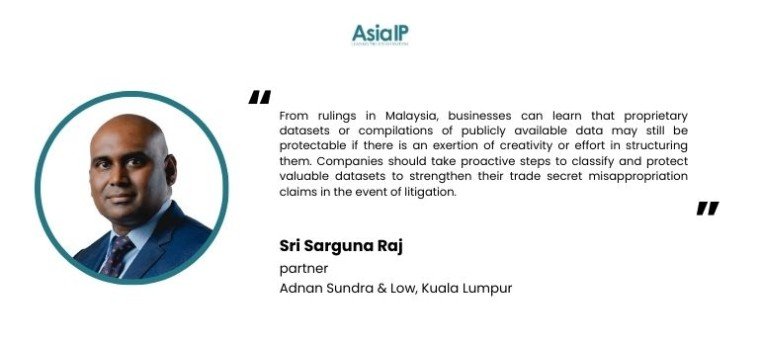
He added: “From these rulings, businesses can learn that proprietary datasets or compilations of publicly available data may still be protectable if there is an exertion of creativity or effort in structuring them. Companies should take proactive steps to classify and protect valuable datasets to strengthen their trade secret misappropriation claims in the event of litigation.”
To establish a breach of confidence, it is important that a plaintiff must demonstrate that the information has the necessary quality of confidence; it was imparted in circumstances importing an obligation of confidence; and that there was an unauthorized use or disclosure that resulted in harm.
Additionally, copyright law under the Copyright Act 1987 may apply if the scraped data includes literary works, databases, or other copyrightable material. If the dataset meets originality and substantiality thresholds, copyright infringement claims could arise against unauthorized scraping and reproduction of the datasets, or its use.
Technical measures also play a crucial role in determining the legality of web scraping. An example of which is Section 36A of the Copyright Act, which prohibits the circumvention of technological protection measures (TPM) applied to copyright-protected works. If a website or database implements TPMs, such as CAPTCHA systems, access controls, or encryption mechanisms, bypassing these TPMs to extract data could constitute an infringement under this provision.
“However, there are exceptions to this restriction, including purposes related to interoperability, security testing, and law enforcement,” said Raj. “Businesses engaging in web scraping should be mindful of whether their activities involve circumventing TPMs, as violating these provisions could result in legal liability. Moreover, companies can enforce website terms of service to further restrict unauthorized scraping, and breach of such terms could strengthen their claims related to breach of confidence and unauthorized use of copyrighted content.”
Furthermore, website terms of service (ToS) has not been explicitly addressed in Malaysian case laws concerning web scraping. However, breach of ToS may give rise to contractual claims if the scraper has expressly agreed to such terms. If the ToS contains clauses restricting automated data extraction and the scraper had notice of and agreed to these terms, a website owner may have a basis to argue breach of contract.
“While violating ToS alone may not necessarily amount to trade secret misappropriation, it could support a broader claim of unauthorized use of confidential information, particularly if the scraped data involves proprietary compilations or business-sensitive information,” said Raj.
Trade secrets in terms of service
Trade secrets are a class of confidential information, and as such are protected under the equitable doctrine relating to the protection of confidential information. “The doctrine has been developed by UK (and now Australian) courts over many decades. It is not the subject of any specific statutes. The protection of confidential information sits alongside other mechanisms of intellectual property protection, including statute-based protection for inventions, trade names and the like,” said Ramchand.
Website terms of service, meanwhile, particularly those which have been explicitly accepted by a browser of the website, form a contract which can control whether automated tools (such as web scrapers) are permitted to be used to browse the site and scrape it. “As a matter of principle, terms of service can prohibit the use of automated browsing systems or agents, such that data scraping would be a breach of those terms,” he said. “It is common for such terms of service to assert copyright in information displayed on the website, and data scraping may, in certain circumstances, involve an infringement of that copyright.”
He added that Australian business and developers who rely on web scraping techniques should ensure that the information they are obtaining is publicly available information (preferably available from multiple sources), and that the terms of service on the relevant website do not prohibit the use of web scraping techniques. “They should also be aware of other possible legal risks, such as breaches of the Privacy Act 1988 where the data being scraped is personal information governed by that Act,” said Ramchand.
For Mohcine Fattah, a senior director at JAH intellectual Property in Doha, violating website terms of service that explicitly prohibit scraping could be considered a breach of contract. “This could be a factor in legal proceedings, especially if the scraped data is also protected by intellectual property or trade secret laws,” he said.
He added that businesses and developers in Qatar who utilize web scraping should prioritize a cautious and legally sound approach to mitigate the risk of trade secret misappropriation. “First and foremost, a thorough understanding of Qatar’s Trade Secrets Law (Law No. 5 of 2005) is essential. This involves recognizing what constitutes a trade secret, which includes confidential information that provides a competitive edge and is subject to reasonable measures to maintain its secrecy,” he said.
Notably, when engaging in web scraping, businesses should carefully evaluate the target website’s content. Avoid scraping any information that could reasonably be considered a trade secret, such as customer lists, pricing strategies, internal financial data, or proprietary processes.
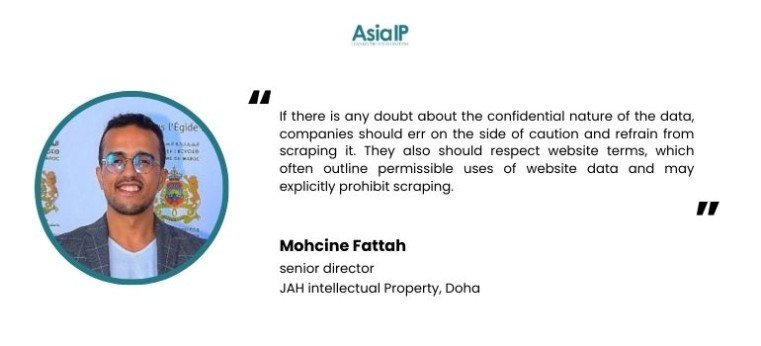
He added, “If there is any doubt about the confidential nature of the data, they should err on the side of caution and refrain from scraping it. They also should respect website terms, which often outline permissible uses of website data and may explicitly prohibit scraping. Businesses and developers should also review and update web scraping practices to stay abreast of evolving legal interpretations and technological advancements.”
Of course, it is very much important that businesses should take steps to protect their valuable data. Hasan added, “This might include having clear terms of service, implementing technical measures to limit scraping (like CAPTCHAs), and actively monitoring for unauthorized data collection.”
Raj added that while Malaysian laws do not specifically regulate web scraping, businesses should be aware that claims for breach of confidence and copyright infringement could still be relevant depending on the type of data involved and the way it is used. He gave pointers.
-
Review website terms of service. Be mindful of restrictions imposed on data scraping and collection to mitigate contractual liability risks.
-
Implement ethical scraping practices. Consider obtaining consent from the website owner or prioritizing using publicly available APIs where possible.
-
Assess the nature of the data. Ensure that the data being scraped is not subject to trade secret protections or copyright claims. If the dataset has been compiled with significant effort and is proprietary, it may be legally protected even if it includes publicly available information.
-
Minimize exposure to confidential data. If scraping business-related data, avoid extracting proprietary compilations or datasets that are curated with commercial value, and only scrape necessary data.