Please wait while the page is loading...

loader

SEP and FRAND in digital health

30 September 2025

SEP and FRAND in digital health

As healthcare goes digital, licensing standard essential patents become critical to access and innovation. Excel V. Dyquiangco explores how Taiwan and India navigate royalty disputes, public interest and evolving IP strategies in the medical technology sector. 


With the world going digital for the past many years, the healthcare sector stands as a prime example of an industry transformed by technological advancements. From sophisticated diagnostic equipment to intricate patient monitoring systems and seamlessly integrated electronic health records, the landscape of modern medicine is built upon a foundation of interconnected devices and digital platforms.  

Yet, behind this seemingly effortless interoperability lies a complex, often unseen, mechanism: standard-essential patent (SEP) licensing. Far from being a mere legal footnote, SEP licensing is the invisible backbone that enables the seamless exchange of information and functionality crucial for effective patient care.  

At its core, SEP licensing protects an invention that is crucial to the application of a specific technology standard. These standards are essential for guaranteeing the compatibility, safety and interoperability of various goods and services offered by different businesses. 

The unique nature of SEPs necessitates a specific approach to their licensing. Because a patented technology is “essential” to a standard, a patent holder can theoretically block anyone from implementing that standard if they choose not to license their SEP. To prevent such monopolistic practices and ensure widespread adoption of beneficial technologies, a critical principle comes into play: fair, reasonable and non-discriminatory (FRAND) terms. 

In Taiwan, the interpretation and application of FRAND terms in the context of SEPs – including those relevant to medical devices, diagnostics or digital health technologies – are primarily guided by the principles set forth in the Patent Act, the Fair Trade Act and relevant judicial precedents. 

According to Ruey-Sen Tsai, a partner at Lee and Li in Taipei, when determining whether licensing terms are FRAND-compliant, the courts in Taiwan may consider factors such as the royalty rates charged to other licensees, the value of the patented technology to the standard and the overall circumstances of the negotiation process.  

“Unilateral refusal to license SEPs or the imposition of excessive or discriminatory royalties may be deemed as abuse of patent rights or as a violation of the Fair Trade Act, particularly if such conduct restricts competition or harms public interest,” he said.  

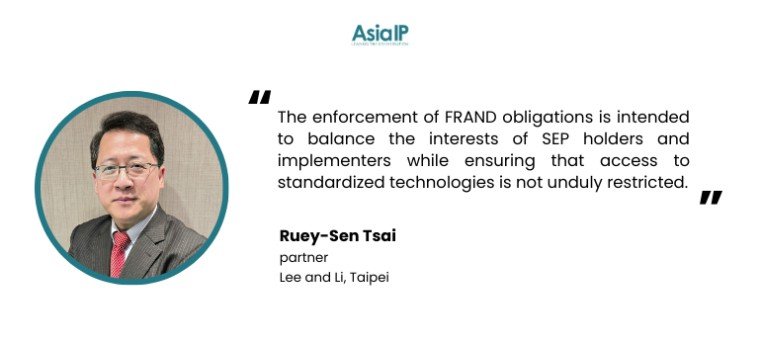
Meanwhile, in the context of medical devices, diagnostics or digital health technologies, the authorities in Taiwan are attentive to the public interest implications, especially where access to essential technologies may impact public health. “Therefore, the enforcement of FRAND obligations is intended to balance the interests of SEP holders and implementers while ensuring that access to standardized technologies is not unduly restricted,” Tsai added.  

This contrasts with India, as there are yet to be any SEPs asserted against medical devices, diagnostics or digital health technologies. The judiciary in India, specifically, the Delhi High Court, has interpreted FRAND in a post-trial judgment dealing with telecommunication patents such as the case of Ericsson v. Lava. The Delhi High Court, in this judgment, has broadly interpreted FRAND in the following manner: 

  • Fair: Encompasses ethical and equitable aspects of licensing, demanding just and impartial terms that balance patent holder contributions with licensee rights. 

  • Reasonable: Focuses on economic aspects, requiring alignment of fees and royalty rates with industry norms and patent value, avoiding exploitative terms. 

  • Non-discriminatory: Prohibits biased practices favouring certain entities over others, ensuring equitable treatment across licensees. 

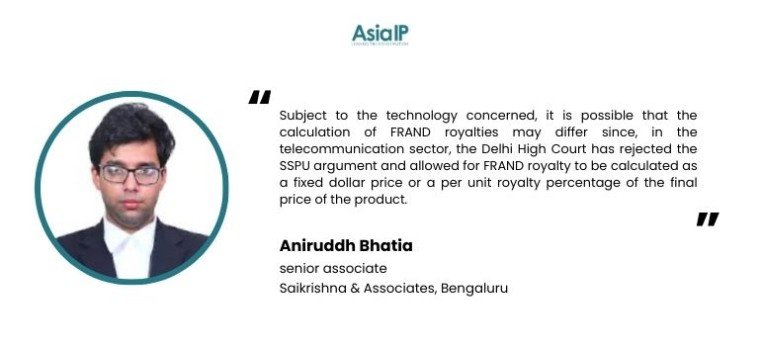
“Given that the Ericsson v. Lava case is a final post-trial judgment, the above interpretation is likely to be followed in all SEP cases, including those pertaining to medical technology,” said Aniruddh Bhatia, a senior associate at Saikrishna & Associates in Bengaluru. “However, subject to the technology concerned, it is possible that the calculation of FRAND royalties may differ since, in the telecommunication sector, the Delhi High Court has rejected the smallest saleable patentable unit (SSPU) argument and allowed for FRAND royalty to be calculated as a fixed dollar price or a per unit royalty percentage of the final price of the product. However, it may take a different view given that the use of the asserted standard may play very little role in the medical device.” 

In the case of Intex v. Ericsson, the Division Bench of the Delhi High Court has made certain observations regarding the FRAND protocol, including observing that it is not “a one-way street” and that the FRAND protocol casts obligations on both the SEP holder and the implementer. In this regard, the Division Bench relied on the judgment of the Court of Justice of the European Union in the Huawei v. ZTE case, which outlines the FRAND protocol to be followed: approach, negotiations and evaluation of patents, offers and counteroffers.  

“Interestingly, the Division Bench also observed that injunctive relief would only be available if the asserted patent was infringed, the SEP holder was willing, i.e. made a FRAND offer (comparable to third parties) and the implementer was unwilling,” said Bhatia. “These observations and tests are relevant as they would likely be applied in a medical device or life sciences SEP case or generally any other SEP matter in any sector from automotive to smart metres.” 

He added that this would, however, be pertinent to note that in pharmaceutical patent (non-SEP) cases, the Indian judiciary has typically taken into consideration the public interest considerations while granting relief to the patentee. In one case, courts in India have shown reluctance to grant interim injunctions in case of patented life-saving drugs, noting that public interest in access to the medication outweighs interest in granting an injunction.  

“Therefore, it is possible that in medical or life sciences SEP cases, the court may adopt a higher standard and threshold than the one laid out in Ericsson v. Lava and Intex v. Ericsson judgments and not entertain the notion of any interim relief such as an injunction or deposit. A higher threshold is perhaps warranted as the medtech sector directly impacts public health and the test applied to mobile or telecom disputes may not be applicable. Given that India hosts a large number of manufacturers of medical technology, both for domestic and international use, and that the end goal of a SEP dispute is FRAND royalty, it cannot be ruled out that the courts may evolve a different mechanism and test for medtech SEP disputes,” said Bhatia. 

Dealing with royalty rates 

In Taiwan, any disputes on intellectual property licensing issues are mainly reviewed by the Intellectual Property and Commercial Court (IPC Court), although other courts and the Supreme Court or the Supreme Administrative Court may also review the relevant issues in certain cases. In the context of life sciences, the IPC Court in Taiwan approaches the determination of royalty rates for SEPs by considering a variety of factors to ensure they align with FRAND principles. 

Tsai said: “While there are limited cases specifically addressing SEPs in the pharmaceutical or biotech sectors in Taiwan, the general principles applied by the IPC Court in Taiwan are consistent with international practices based on the Fair Trade Act and the Patent Act as well as relevant regulations.”  

He noted the following factors: 

  • The scope and duration of the patent rights, as well as the geographic coverage of the license 

  • The value of the patented technology in relation to the overall product, particularly its contribution to pharmaceutical or biotech innovation 

  • Comparable licensing agreements, especially those that are part of global licensing arrangements, to assess prevailing market rates 

  • The history of negotiation and any existing industry standards 

  • The economic benefits derived from the use of the SEP in the relevant life sciences field 

“While the jurisprudence in Taiwan regarding SEPs in pharmaceuticals and biotech is still developing, the courts strive to align their approach with international norms, particularly in the context of global licensing agreements. The IPC Court in Taiwan may sometimes refer to expert testimony and economic analyses to determine an appropriate royalty rate. In the absence of specific statutory guidelines for SEPs in the life sciences, the IPC Court exercises considerable discretion, guided by the principles of equity and the need to balance the interests of patent holders and licensees,” said Tsai.  

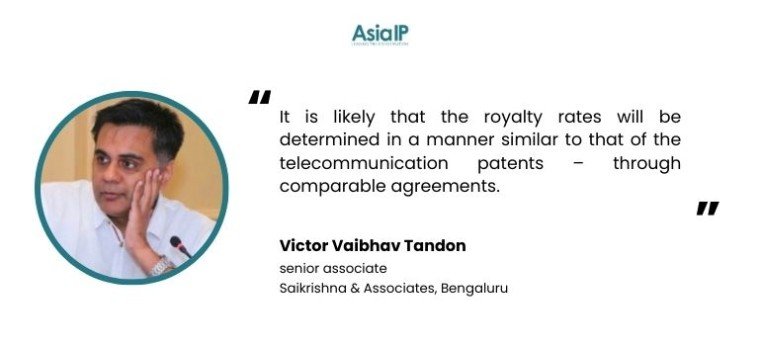
In India, there haven’t been any life sciences-related SEP disputes yet. “However, it is likely that the royalty rates will be determined in a manner similar to that of the telecommunication patents – through comparable agreements,” said Victor Vaibhav Tandon, a senior associate at Saikrishna & Associates in Bengaluru. 

He added: “The Delhi High Court in Ericsson v. Lava conclusively used third party comparable licence agreements to determine the FRAND royalty rate payable rather than a top-down approach. Although patent rights are territorial, the court in this case, awarded damages based on global portfolio.” 

Tandon said that even in the context of life sciences, royalty rates are likely to be calculated based on comparable licenses.  

“If the SEP in question is part of a global licensing arrangement, the court is likely to take into consideration the economic and social situations of the countries where the SEP is being licensed and the product manufactured and accordingly adjust that to India,” he said. “Additionally, as stated above, Indian courts are likely to give due consideration to factors such as public interest and availability of such technology to ensure affordability, especially if the product is a lifesaving technology. The courts have, time and again, in non-SEP pharma cases, taken into consideration the pricing and availability of patented life-saving medication. Therefore, the court may also evolve a different methodology to compute FRAND rate for med-tech devices to ensure that the pricing and consequent affordability is not hampered.” 

SEP disputes and practices 

The most common legal challenges or disputes arising from SEP licensing in Taiwan, particularly in the medical technology and healthcare IT sectors, generally involve the following issues: parties often disagree on what constitutes FRAND in terms for SEP licensing, including disputes over royalty rates, scope of license and other licensing conditions.  

“Furthermore, the validity of the asserted SEP or whether the patent is truly essential to the relevant standard are frequently raised,” said Tsai. “Besides, disputes may arise regarding whether the SEP holder’s licensing practices violate the Fair Trade Act, particularly in cases involving refusal to license or discriminatory licensing.” 

In India, generally the following legal challenges are evident in SEP or FRAND litigations thus far: 

  • No essentiality checks. Globally, SEPs are self-declaratory and not verified by an independent authority. As such, considerable time is spent in ascertaining the essentiality of the patents, with the implementers often challenging the validity in addition to the essentiality. 

  • Prolonged interim relief. Interim and pro tem reliefs are argued at great length, delaying the actual trial and findings. 

  • Delay in sharing of comparable license agreements and FRAND calculation. SEP holders often delay sharing comparable licence agreements with representatives of defendants, which prolongs the litigation. It is possible that many disputes could be shortened if the relevant agreements are made available expeditiously. 

  • Reluctance for alternative dispute resolution (ADR). While SEP holders do not usually wish to engage in pre-suit mediation, equally implementers are unwilling to pursue a confidential ADR proceeding, such as arbitration – perhaps because arbitrations cannot determine essentiality of patents. It is likely that the same problems will emerge in the medtech SEP segment as well. 

Considering the critical nature of health products, some best practices companies in the life sciences sector should follow include:  

For SEP holders: 

  • Send detailed notices of infringement, identifying the situs of infringement, mode and manner of infringement, along with claim charts establishing essentiality. 
    The SEP holder ought to provide their FRAND offer along with a detailed computation basis thereof (often, the computation is missing). 

  • The SEP holder should also endeavour to provide as much information as possible on the comparable licensing agreements and can even do so through a confidential mechanism of the Court such as pre-suit mediation. 

For SEP implementers: 

  • It is imperative not to delay negotiations and execute non-disclosure agreements (if required) in a timely manner. 

  • SEP implementers also ought to do a technical assessment and provide questions for the validity and essentiality of the SEPs (if there are any such questions). 

  • SEP implementers also ought to seek the computational basis for the SEP holders offer as well as details of comparable license agreements. 

  • SEP implementers should provide their counter offers with computational basis. They should however clearly state that the offers are not admissions on essentiality or validity. 

“The above practices are likely to avoid litigation altogether and encourage parties to settle,” said Tandon. 


Law firms