Popular transportation and transit hubs
“Filing in jurisdictions that serve as key major transit points such as Hong Kong or Singapore can add strategic value, even if they may not be large end-markets themselves for a company,” noted Sher Hann Chua, TMT/IP counsel at Linklaters in Hong Kong.
Legal environment
Take into account the legal environment in those jurisdictions where you plan to apply for patent protection. Assess the strength, efficiency and impartiality of enforcement. Evaluate patentability standards, invalidation risks, litigation costs and typical timelines for relief. The U.S., Germany and Japan have well-developed patent litigation systems. These jurisdictions are also highly efficient when it comes to holding patent infringers accountable.
Fast patent systems
Consider jurisdictions with fast examination processes such as Australia and New Zealand. Add to these the Patent Prosecution Highway (PPH). Under the PPH, companies applying for patent protection in a participating jurisdiction may utilize examination results from patent offices of other participating jurisdictions to accelerate substantive examination. Meanwhile, a single examination under the European Patent Office can result in patent validation across 42 jurisdictions.
“Where patent applications are driven by specific goals, such as to meet an investment requirement, the ability to obtain timely protection is key,” said Chua.
Aside from awarding patent grants more quickly, fast patent systems also help settle contentious matters more speedily. Often, this provides an indication of the outcome of proceedings in the larger markets where the process is longer and therefore costlier.
International treaties, regional systems
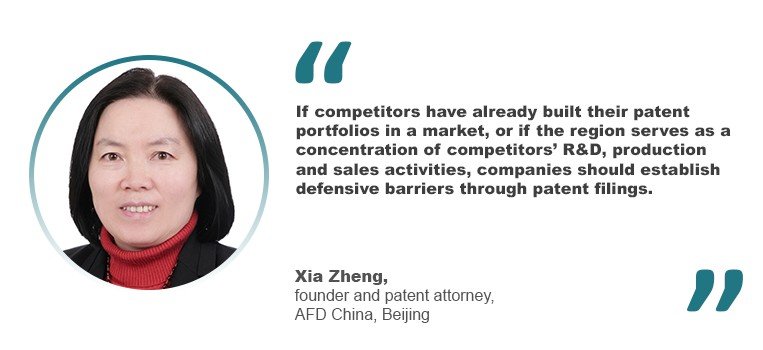
Take the Patent Cooperation Treaty (PCT), for example. Under the PCT, you may file a single international application for patent protection in multiple jurisdictions. “Companies may initially secure coverage in high-value markets through the PCT system,” said Zheng, “then strengthen protection in key jurisdictions.”
According to Zheng, technology companies targeting global markets for their products may want to enter the U.S., Europe, Japan and other core jurisdictions first via PCT filings. Doing this will establish patent barriers. “This creates a foundation for future market entry,” she noted.
Meanwhile, regional patent or design systems such as the Unified Patent Court or The Hague System for industrial designs, can also simplify the multinational filing processes. The Hague System offers design protection in up to 99 jurisdictions with just a single application.
“Where production locations and export destinations are limited and well-defined, direct national filings under the Paris Convention for the Protection of Industrial Property may suffice. For operations with multiple production locations/export destinations or uncertain market prospects, an optimal strategy involves first filing PCT applications in major export destinations and later deciding on whether to enter other PCT member states,” Zheng advised.
In addition, a single application to the European Patent Office also covers multiple member jurisdictions.
Licensing and partnership opportunities
If licensing or partnerships are in the pipeline, you may want to file for patent protection in jurisdictions where potential licensees operate.
Cost and administrative burden
Remember that costs vary in each jurisdiction. These include costs of translation requirements, annuity fees and attorney costs. “Prioritizing a limited number of key jurisdictions can optimize budgetary efficiency,” advised Klaysri.
Patenting strategies for startups and small businesses
Even with limited resources, startups and small business can still be strategic when identifying the most valuable markets for their patents.
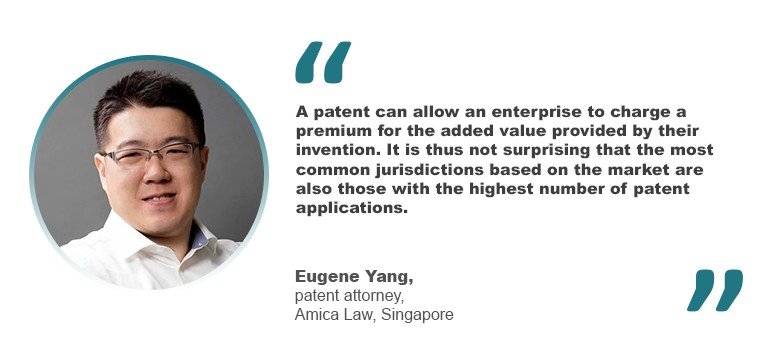
Of course, it still begins with having a holistic IP strategy. “While registerable IP like patents, trademarks and designs offer enforceable rights with a distinct scope, there are costs involved which can add up when filed in many jurisdictions,” said Yang. “Non-registerable IP like trade secrets may also be important to a startup or small business and there are no registration costs.”
As mentioned above, the PCT, Hague System and PPH, among others, are practical options for patent applicants, especially those with limited budgets such as startups and small enterprises.
The PCT system for international applications leverages the 12-month priority period and the 30/31-month national phase entry window. This provides critical time for technical verification and market evaluation before determining target jurisdictions for patent filings.
“For instance, a hardware startup could first file a PCT application, use the International Search Report to assess its technology's novelty, and then strategically decide whether to pursue protection in core jurisdictions such as the U.S. and Europe based on the patent density in these markets,” Zheng explained.
If the company is eyeing the Southeast Asian market, there’s also the ASEAN Patent Examination Co-operation (ASPEC) programme. Though ASPEC does not offer unified grant procedures, it does help simplify the application process in several jurisdictions within ASEAN.
All of these programmes save time, effort and costs which will work well for startups and small businesses.
Aside from these and the other key considerations outlined above, our interviewees provided a few more guidelines specifically for small companies:
Consider the dominance of jurisdictions in certain regions. “For example, if North America is a key market, then patent protection in the U.S. alone is likely to be sufficient and protection may not also be needed in Canada and Mexico. A competitor is unlikely to be able to viably compete if they can’t operate in the U.S., even if they can operate in Canada or Mexico,” said Lucas.
Aside from filing in the major markets, build fundamental barriers for your core patents by filing in the jurisdiction of technological origin, such as where R&D work is being done. Zheng says that AI companies should file patents for algorithms in the U.S., China and the EU and maximize protection scope by leveraging differences in examination standards. As an example, examination standards in the U.S. focus on business methods while those in China lean more toward technical solutions.
For peripheral patents, create a “patent thicket” by filing in jurisdictions where the technology is widely applied. This will help restrict technological iteration by competitors.
Companies should ensure strategic position of standard-essential patents (SEPs). “For technologies tied to international standards such as 5G and IoT, patent applications should be simultaneously filed in key standard-setting jurisdictions such as the U.S., China and South Korea, and obtain the qualification for global market access through FRAND licensing commitments,” Zheng said. “For instance, a communications equipment provider that files patent applications in the U.S., China, Korea, and Europe during 3GPP standard formulation process can secure a dominant position in subsequent licensing negotiations.”
Lawyers also advise that companies use patent maps regularly. A patent map is a helpful tool as it allows a company to analyze technological gaps and competitive dynamics in target markets. For a company in the new materials business, a patent map could reveal a potential market. The patent map may indicate that the patent layout for nanocoating in that market is relatively underdeveloped, opening an opportunity for the company, which might want to fill that gap and establish a technological barrier.
“There is a lot of free public information to increase the awareness of IP to startups and businesses. However, this information tends to be just the tip of the iceberg, and may not be the most suitable or appropriate for the startup or company,” Yang said.
Hence, Yang recommends seeking the services of a patent agent or attorney who will advise on suitable strategies based on an individual company’s needs, including where to file for patent protection.
“I would just also point out that there is some point when the selection of countries needs to occur. After that point, it is not possible to file in more countries,” Lucas said. “So if there are doubts as to whether to file in some countries, it would be safer to do so. If those countries prove to be less important, then the applications can be easily dropped, but it is not possible to change your mind and add additional countries later.”
Klaysri added that patent filing strategies or patenting strategies must be integrated early on in product development, instead of treating it as a post-development formality. Patent filing, he stressed, is a core component of comprehensive market entry planning.