Please wait while the page is loading...

loader

AI-assisted creative works: How to prove human creativity, copyright ownership

15 March 2026

AI-assisted creative works: How to prove human creativity, copyright ownership

Proving copyright ownership of AI-assisted works is becoming increasingly complex. Lawyers tell Espie Angelica A. de Leon how different jurisdictions are addressing the issue and what creators can do to protect their rights. 
 

If you’re an artist, designer, writer or any other creative worker, you’ve probably used artificial intelligence tools in your job, whether it’s ChatGPT, Midjourney, DALL-E or Runway.  

It’s a no-brainer – AI automates routine chores such as formatting, rendering and editing. Generative AI (GenAI) in particular can quickly produce new images, texts, videos and music for artistic content. This is useful for image-to-video generation, background removal and other applications. Overall, AI speeds up the work process, making things more cost-efficient for the creative industry professional or the business enterprise engaged in creative services. 

However, not all jurisdictions have laws or regulations expressly governing copyright and AI-generated or AI-assisted artistic creations. Also, some jurisdictions do not require copyright registration, hence they have no registries. Australia and New Zealand are among them.  

So, the questions are: What if someone infringes on a creator’s copyright over his AI-assisted creative work? How will the creator prove copyright ownership over something that he created with the aid of AI? More specifically, how will the copyright owner prove that he exercised creative control and infused his artistic creation with his own human contribution? 

Evolving laws and regulations 

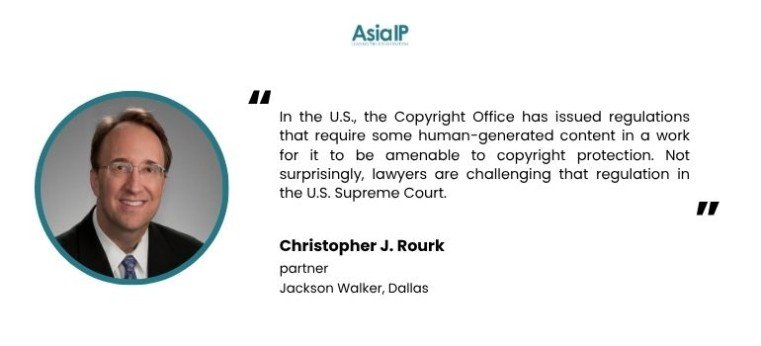
“In the U.S., the Copyright Office has issued regulations that require some human-generated content in a work for it to be amenable to copyright protection,” said Christopher J. Rourk, a partner at Jackson Walker in Dallas. “Not surprisingly, lawyers are challenging that regulation in the U.S. Supreme Court. Whatever the outcome of that dispute might be, it is certain that copyright law will continue to evolve in the U.S., even if the current framework is upheld in the pending case.”  

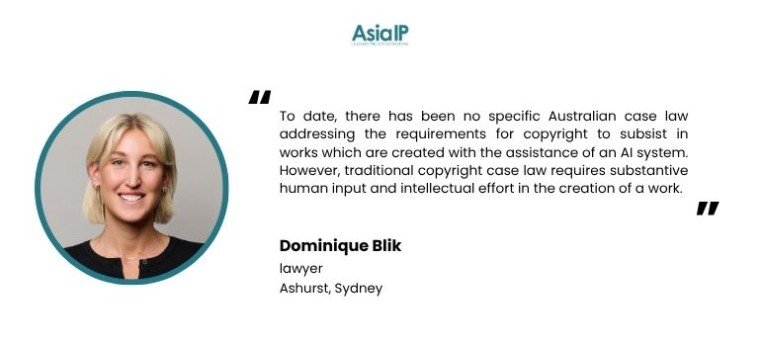
“To date, there has been no specific Australian case law addressing the requirements for copyright to subsist in works which are created with the assistance of an AI system. However, traditional copyright case law requires substantive human input and intellectual effort in the creation of a work. That is, there must be a human ‘author,’” said Dominique Blik, a lawyer at Ashurst in Sydney. 

As in Australia, copyright laws in China, India, Vietnam and New Zealand do not contain specific rules or provisions for AI-developed or AI-assisted artistic creations or content. 

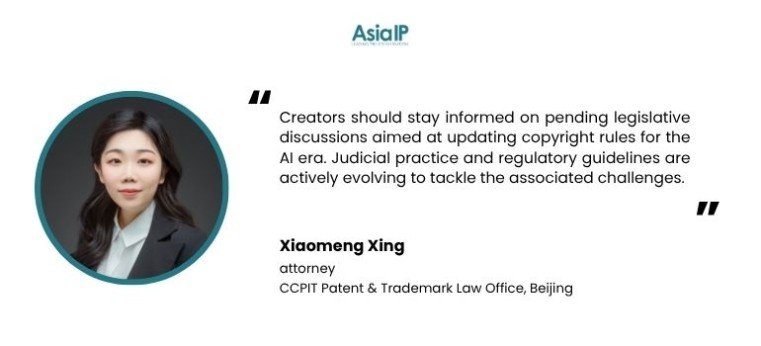
“However, judicial practice and regulatory guidelines are actively evolving to tackle the associated challenges,” revealed Xiaomeng Xing, an attorney at CCPIT Patent & Trademark Law Office in Beijing. 

According to her, Chinese courts have begun ruling on cases involving AI-generated creative content. These cases tackle issues such as copyrightability, infringement determinations, including fair use and the liability of AI service providers. “The judicial exploration remains in a state of evolution,” Xing noted.  

Industry regulations in China are also evolving. Changes now include the mandatory labelling of AI-generated content and platform-specific governance rules. 

“Issues relating to works created using AI can be addressed through existing provisions of the Copyright Act, 1957, particularly those dealing with authorship, originality and computer-generated works,” said Sudeep Chatterjee, a senior partner at Singh & Singh in New Delhi. 

He mentioned the landmark case Eastern Book Company v. D.B. Modak. India’s Supreme Court held that for copyright to subsist, a creative or artistic work must possess a minimal degree of creativity and substantive variation to prove that human intervention significantly contributed to the outcome. “If a human exercises creative judgment, makes artistic or intellectual choices and uses AI merely as an enabling tool, such a work may satisfy the originality requirement and be examined under Section 2(d)(vi). However, merely providing prompts or instructions to an AI system, without exercising creative control over the output, is unlikely to meet the modicum of creativity threshold required under Indian law,” Chatterjee explained. 

In December 2025, India’s Department for Promotion of Industry and Internal Trade (DPIIT) published Part 1 of its Working Paper on Generative AI and Copyright. The paper is based on recommendations by the eight-member committee formed by the DPIIT in April 2025 to examine India’s copyright law against the ramifications of Generative AI adoption. Among the issues discussed was copyright infringement. “The paper concluded that India needs a new policy framework to balance modern cultural changes, protect incentives for human creators and build effective AI systems. Thus, current copyright laws, per se, don't fully exclude AI-assisted work, but there's growing emphasis on creating a specific copyright framework for AI in the future,” Chatterjee revealed. 

Vietnam’s IP Law has been amended and will take effect on April 1, 2026. The amendments seek to expressly resolve the issue of copyright ownership in the case of AI-assisted works. As of press time, the government’s decree on the issue is still being drafted. “In particular, the draft decree expressly states that copyright will not arise where a work is generated entirely by AI or otherwise fails to meet statutory requirements, and requires a work to reflect ‘meaningful and decisive’ human creative contributions to be copyrightable,” said Cam Tu Nguyen, an associate at Baker McKenzie in Hanoi. 

Meaningful and decisive human creative contributions may come in the form of prompts. In the creative process, prompts are used to control the AI system. Likewise, evaluation, selection, edition, interference with or interpretation of results generated by the AI system are examples of meaningful and decisive human creative contributions. So with the acts of selection, arrangement and organization of content in order for the artistic creation to take shape. Making artistic, aesthetic or professional decisions with regard to the creative work and/or determination of the final outcome are other forms of meaningful and decisive human intervention.  

The New Zealand Copyright Act 1994 likewise makes no express mention of AI. There seems to be no plans to update the act to expressly address copyright issues in the face of GenAI either.  

“However, the act does provide that copyright may subsist in ‘computer-generated’ works, and that the author of such work will be ‘the person by whom the arrangements necessary for the creation of the work are undertaken,’” shared Blake Carey, a senior associate at AJ Park in Auckland. 

“A computer-generated work is a work that is generated by a computer in circumstances such that there is no human author of the work. This broad definition would capture certain AI-generated works.  What this all means is that, in New Zealand, copyright can subsist in works that are produced by generative AI, rather than by a human,” he explained.  

When copyright ownership is questioned and how to prove it 

The question of copyright ownership arises when an infringement lawsuit is filed and litigation takes place. The plaintiff must then prove he is the author or lawful owner of the AI-assisted content or artistic work. 

Litigation can also happen when a declaratory judgment lawsuit is filed. “An accused infringer can also challenge the validity of the registration and whether the applicant was truthful regarding the extent to which AI was used to create it,” said Rourk. 

Copyright ownership is also central in transactions involving intellectual property, such as licensing or assignments, when issuing takedown notices and during dispute procedures on online platforms. 

In these situations, how does a creator prove ownership in the absence of adequate laws and regulations and copyright registries? 

The keyword is “documentation.” Clear and comprehensive documentation. Copyright owners must document the whole process of creating an AI-assisted work early on to provide evidence of “originality” and “creativity.” 

What were the AI tools used? When were these tools used? What were the “prompts” that were inputted? The documentation must cover these details.  

The prompts must also be chronologically logged. Accordingly, the log must specify how each prompt was refined or adjusted. “Include explanations of why prompts have been adjusted and the creative object being pursued,” said Nina Fitzgerald, a partner at Ashurst in Sydney. 

It is advisable to save screenshots of these prompts or other digital documents containing such. “Such documentation helps to show that the human was not merely pressing a ‘generate’ button,” Chatterjee pointed out, “but was actively guiding the AI’s output through interactive and creative decisions.” 

Creators must keep metadata for their works, such as filecreation dates, versioncontrol logs or cloudstorage histories. 

Keeping records showing capture design conception and development, and demonstrating human selection, arrangement, editing, curation and other creative judgements or editorial choices is also important. 

Screenshots of outputs must be saved as well. These may include drafts, dated manuscripts, contracts, correspondence and other related records “Saving the materials in a digital format that can be easily authenticated as to date and content will make proving the providence of the material easier in court,” said Rourk. 

Rejected AI outputs must also be preserved. “Clearly specify where human edits, reordering or reframing have altered the AIgenerated material. Where the work combines multiple AIgenerated segments, such as several images or text blocks, documenting the humandriven selection, sequencing and compositional choices can further support a claim that the final arrangement reflects the author’s own intellectual effort,” said Chatterjee. 

“Given how most generative AI tools work nowadays, it is advisable that owners save the chat history in which they coordinate the system to create the work, which should contain all the prompts, drafts and timestamps,” advised Manh Hung Tran, a partner at Baker McKenzie in Hanoi. 

Copyright owners may also use trusted blockchain notarization services. 

“The owner should also carefully check the terms and conditions of the AI tool that they used, to see if there are any terms that could conceivably impact the chain of ownership,” said Carey. The same goes for platforms that are popular among creatives, such as Upwork and Fiverr. 

The rise of AI-generated and AI-assisted creative works  

Xing advises creators to stay informed on pending legislative discussions aimed at updating copyright rules for the AI era.  

The evolution of legal and regulatory frameworks isn’t surprising. AI continues to penetrate our work life, cutting across multiple industries, including the creative service industry.  

According to Xing, AI-assisted creations are highly prevalent in China, with a domestic user base reaching hundreds of millions.  

“As is the case in most jurisdictions, AI-developed and AI-assisted creative works in the U.S. are growing in use and popularity, from text and images to songs and videos,” Rourk added.  

“AI-developed or AI-assisted creative works appear to be increasingly used by businesses in New Zealand. While there is no New Zealand case dealing expressly with these issues, we would anticipate this will change soon,” revealed Carey. 

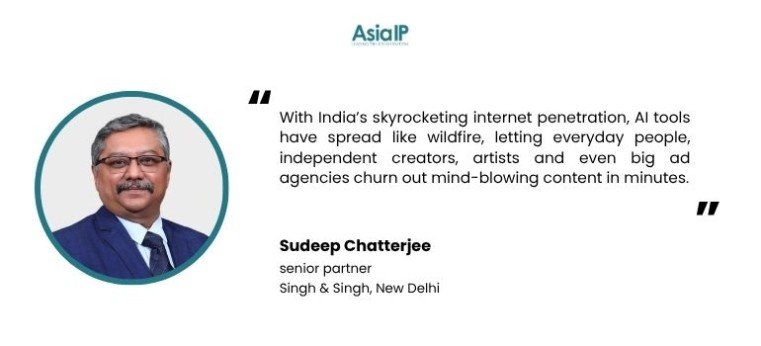
The same scenario plays out in India, where AI-developed and AI-assisted creative works have been grabbing the attention of Generation Z over the past two to three years. “With India’s skyrocketing internet penetration, these tools have spread like wildfire, letting everyday people, independent creators, artists and even big ad agencies churn out mind-blowing content in minutes. In fact, social media is where AI-generated content truly thrives. Platforms like Instagram, WhatsApp and X are filled with such AI-generated content,” Chatterjee said. 

In Vietnam, where several AI-developed advertisements have emerged,  

AI-assisted creativity is a controversial topic. The idea of using AI to produce artistic content or creative works is generally unpopular among Vietnamese creators. “The controversy within the local creative sector has also somewhat driven public perception, setting a low expectation in consumers of the quality of AI-generated works. Similar to many countries around the world nowadays, AI-generated products or slops of low artistic value are much more ubiquitous in Vietnam than high-quality products,” said Tran. 

Nevertheless, general AI uptake in Vietnam is high. According to the PwC Global Workforce Hopes and Fears Survey 2025 for Vietnam, 83 percent of employee responders said they are using AI in their job. Thirty-eight percent reported using GenAI every day. This is more than double the global average. “Though the reception may vary depending on the quality of each work, it is true that GenAI tools are no longer negligible choices for creation,” said Nguyen. 

When using AI tools, creative industry professionals shouldn’t let their guard down. The internet allows ease of access to their creative works. With more people consuming their artistic creations – whether it is a visual art, a piece of music, video or movie – the possibility of an unscrupulous individual copying their work and infringing on their copyright looms even larger. This problem may be compounded by inadequate or unclear laws and regulations, plus the absence of a copyright registry. Hence, creatives must document in detail their creative process for every piece of work they’ve done, in every stage of the entire workflow. 


Law firms