

Evolving IP trends in 2026
05 January 2026

Artificial intelligence, green technology and digital innovation are rewriting the rules of IP. Excel V. Dyquiangco explores how evolving definitions of authorship, sustainability goals and data-driven value are reshaping IP laws, enforcement and strategy.
As 2026 unfolds, the intellectual property landscape is being fundamentally redefined by rapid technological acceleration. The once-theoretical challenges posed by artificial intelligence are now practical realities, forcing a global re-examination of authorship, inventorship and ownership. Legal and corporate frameworks are racing to address the complexities of AI-generated creations – from intricate designs to complex technical solutions – and questioning the very human-centric foundations of patent and copyright law.
But beyond artificial intelligence, other powerful forces are shaping the future of IP. The continued expansion of immersive digital worlds and the metaverse is creating new frontiers for trademark and brand protection, while the global push for sustainability is fuelling a surge in green technology patents.
Meanwhile, the strategic value of data as a core business asset elevates the importance of robust trade secret protection.
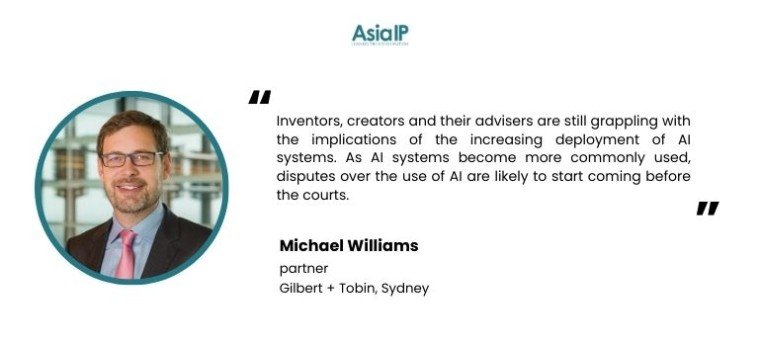
“AI will continue to be a key area of focus in 2026,” said Michael Williams, a partner and head of technology and IP at Gilbert + Tobin in Sydney. “Inventors, creators and their advisers are still grappling with the implications of the increasing deployment of AI systems. As AI systems become more commonly used, disputes over the use of AI are likely to start coming before the courts. There is also activity in the policy space.”
He said that another area of technology where there have been ongoing challenges for IP protection is the patentability of computer-implemented inventions. “Australian courts at trial and on appeal had delivered a series of rulings invalidating numerous computer-based inventions and signalling a highly restrictive approach to patent protection for software-based systems. There was a significant ruling by the Full Court of the Federal Court of Australia in Aristocrat Technologies Australia v. the Commission of Patents, which departed from the previous authority and is widely expected within the IP profession that it will pave the way for the protection of a wider class of software-based inventions from now on,” he said.
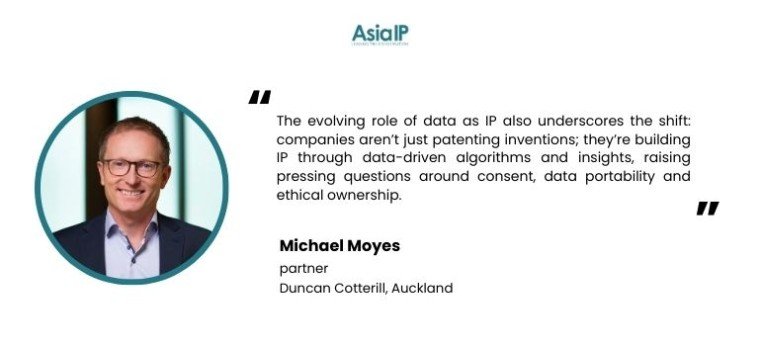
The same is true in New Zealand. According to Michael Moyes, a partner at Duncan Cotterill in Auckland, rapid innovation in software, generative AI (GenAI) and AI-generated content is already pushing the boundaries of New Zealand’s IP frameworks. He said that issues like authorship, ownership, infringement risk and licensing remain unsettled and are expected to drive legal reform over the next couple of years.
“The evolving role of data as IP – especially through AI models and proprietary datasets – also underscores the shift: companies aren’t just patenting inventions; they’re building IP through data-driven algorithms and insights, raising pressing questions around consent, data portability and ethical ownership,” he said.
Among the trends he sees in 2026 are biotech and gene editing; cleantech, agritech and green tech; and, in particular in New Zealand, cultural IP and Māori sovereignty.
“New Zealand is moving toward loosening its regulatory stance on gene editing, aiming to streamline commercialization of low-risk gene technologies by end of 2025. This signals that biotech will be a hotbed for IP policy engagement in 2026, especially around patentability, regulatory exemptions and how indigenous knowledge (taonga) intersects with biotech IP,” he said. “Also, innovations in renewable energy, sustainable agriculture and environmental tech – like smart water management, emission-detecting robotics and virtual fencing – are booming in New Zealand.”
Moyes said that the Ministry of Culture and Heritage released a draft long-term Insights Briefing, exploring how digital technologies (including AI) will reshape creative expression, content distribution and cultural preservation. “The draft briefing paper recognizes the importance of mātauranga Māori, the holistic indigenous knowledge system of the Māori people, to our unique identity as New Zealanders. Mātauranga – including Te Reo Māori (the Māori language) and indigenous governance – is vital in shaping how cultural stories are created, managed and protected using emerging technologies. Māori-led innovation, kaitiakitanga, and indigenous data sovereignty are critical principles throughout the analysis,” he said.
Healthcare, FMCG and automobiles
In Singapore, GenAI is set to be the most significant force reshaping intellectual property law, primarily by challenging the core concept of authorship. In copyright, while the Intellectual Property Office of Singapore (IPOS) has provided initial guidelines, the legal standards remain ambiguous. According to Gilbert Leong, a senior partner at Dentons Rodyk & Davidson in Singapore, the courts and regulators must still provide clarity on what constitutes “sufficient engagement of the human intellect” or “significant creative or editorial control” to determine ownership over works produced with AI assistance.
This dilemma of human involvement extends into patent law, particularly with the rise of innovations like AI-generated drugs. Leong said that the challenge lies in determining inventorship when multiple stakeholders contribute to a discovery. He said that it is unclear whether the rightful inventor is the AI model’s developer, the prompt engineer guiding the output, or the scientist who analyzes the results to identify the ideal drug.

“I see this as becoming increasingly challenging to enforce one’s IP rights or monitor instances of infringement because of the ease with which variations of existing works can now be created due to the emergence of generative AI,” said Leong. “For example, a company’s name and trademark may have been ingested by a large language model (LLM) and have become part of the dataset. A user may use the LLM to generate a publicity poster for an activity which was in the company’s field. The poster which the LLM generated contained the company’s trademark and the user used that poster. This may be an infringing use of the trademark, but the poster was really produced by the LLM. Should the company be held liable? Arguably yes.”
In India, intellectual property law will be influenced by the expansion of fintech, healthcare, fasti-moving consumer goods (FMCG) and automobiles in 2026. The recent goods and services tax (GST) overhaul, for instance, reduced rates on a range of consumer goods, giving households more spending power and encouraging companies to expand production locally. With India’s United Payment Interface system now powering over 20 billion transactions each month, making it the world’s largest real-time payments network by volume, the automobile industry, which contributes about 7 percent to India’s gross domestic product, is expected to reach US$300 billion by 2026.

“As firms bring more manufacturing and product development into India, innovation is being generated closer to the market, resulting in higher volumes of trademark, design and patent filings,” said Madhu Rewari, a partner at Anand and Anand in Noida.
In healthcare, India is the fourth-largest medical devices market in Asia, and the sector is expected to grow to US$30 billion by 2030. The overall retail sector, valued at US$1.06 trillion in 2022, is projected to expand to US$1.93 trillion by 2030, reflecting rising consumer demand and growth in categories such as FMCG and consumer durables.
“Together, these industries are driving demand for trademarks, designs and patents as more product development and brand creation take place domestically, supported by higher consumer spending power following GST rate reductions,” said Rewari.
Of course, AI will always be there. Digital content, according to Mudit Kaushik, a managing associate at Anand and Anand, has become the principal arena for intellectual property enforcement in India, with both human-generated and AI-produced works testing the limits of existing law.
“Rights holders face mass unauthorized reproduction, remixing and cross-platform distribution of music, films and broadcasts. Courts have responded with dynamic injunctions that extend relief to mirror links and future uploads, along with orders compelling intermediaries to disclose uploader identities. These measures indicate a recognition that enforcement must keep pace with the speed at which content circulates online,” he said.
He added: “AI-generated works add further uncertainty. Tools capable of producing text, images, music and AI-generated or synthetic video blur questions of authorship and ownership, while also enabling deepfakes and impersonations that compromise copyright and personality rights. Under the Copyright Act, 1957, only a human can be recognized as an author, leaving AI outputs in a grey zone and raising doubts about who may enforce rights, whether the developer, the user, or neither. Indian courts are beginning to treat unauthorized AI-generated likenesses with the same seriousness as conventional infringement, extending protection to names, voices and images of public figures. In 2026, effective enforcement will depend on combining AI-enabled monitoring with a judicial framework that protects both creative works and digital identity.”
Sustainability and green technologies
Moyes said that New Zealand’s government has already explored this space via grants and incentives.
“However, the green energy space suffered a fairly significant setback with the liquidation of SolarZero – which was a private enterprise, backed by senior lenders and the government’s New Zealand Green Investment Finance (NZGIF) – providing solar energy solutions to residential homeowners,” he said. “Partly in response to SolarZero’s liquidation (and considerable debts to its funders), NZGIF is being dismantled.”
“On the IP front, we expect a surge in cleantech and agritech IP filings,” he added. “The government continues to invest in sustainable innovation via grants and subsidies, such as through the Energy Efficiency and Conservation Authority, and incentivizing renewable energy adoption. We also have clients delivering new services, including solar energy solutions to farming.”
For Leong: “We foresee an increase in green trademark and patent applications, bolstered by IPOS’s present initiatives such as the Tech Insights through Patents (TIP) for green technologies. This allows potential applicants to understand the landscape, aids decision-making (whether to focus on research and development in-house or to co-develop with someone else who is already along in the developmental process). There are also the new patents and trademarks acceleration programmes, SG Patents Fast and SG Trade Marks Fast.”
According to Williams, there is a growing recognition among innovators of the need to maximize available protection under IP laws with the huge increase in investment in green technologies. “This has led to the filing of more patents covering green products and processes. We are already seeing more disputes coming before the courts between rival developers of green technologies. This may signal a change in the nature of IP cases heard before the court,” he said.
In India, the emphasis on sustainability is increasingly visible in intellectual property protection. According to data published by the European Commission, since 2016, more than half of all patents granted in the country have related to green technologies. In total, 61,186 patents were issued in this field, with more than 90 percent focused on waste management and alternative energy production methods.
“For innovators, clean-tech protection has moved into the mainstream, covering renewable energy, waste reduction, energy-efficient materials and biotechnology applications that reduce environmental impact,” said Rewari.
A major development is the Eco-mark Scheme. The Ministry of Environment, Forest and Climate Change has notified revised rules under the scheme, originally introduced in 1991 and amended in 2024, establishing a structured process for awarding the Eco-mark to products that satisfy defined environmental standards. “This provides a regulatory basis for eco-labelling that businesses can adopt across product categories,” said Rewari.
Greenwashing is also under scrutiny. “Companies are increasingly using trademarks and labels to market environmental credentials, and regulators are imposing stricter conditions to ensure that such claims are specific and verifiable. The revised Eco-mark rules aim to reduce misleading practices by laying down clear certification criteria. This framework gives consumers reliable indicators of sustainability and obliges companies to align their branding with demonstrable environmental performance,” she said.
Strengthening IP in 2026
Williams said that this is an important time for companies to review and strengthen their IP portfolios. “Recent decisions in copyright, patent and trademark law in Australia provide opportunities for well-advised clients to maximize the benefit of their intellectual property, particularly in the digital technology space.”
For Rewari, companies planning to strengthen their IP portfolios in 2026 should focus on securing protection that extends beyond primary brands. “Alongside core trademarks, it is prudent to register variations and consider non-traditional signs such as product shapes, packaging or interface features where these play a role in consumer association. Copyright protection should also be factored into portfolio strategy, particularly for creative works, digital content and software, where registration can provide evidentiary value in enforcement. Indian courts have shown readiness to uphold both trademark and copyright rights when supported by clear proof of use or authorship. For businesses with wider ambitions, seeking recognition as a well-known mark or judicial affirmation of reputation can establish broader protection across categories and markets,” she said.

Kaushik, meanwhile, added that enforcement will be most effective when prepared in advance rather than pursued case by case. “Companies should maintain well-documented records of use, assemble material that can be readily deployed in proceedings, and develop strategies for injunctions that cover not only identified infringers but also future iterations of the same conduct. With regulators scrutinizing environmental claims and advertising more closely, it is equally important that sustainability marks, eco-labels, and related branding be supported by verifiable evidence. In 2026, the strongest portfolios will be those that combine carefully structured registrations with credible substantiation and readiness to enforce rights across both traditional and digital arenas,” he said.